Trump and tariffs :
I’m now blogging at Substack. I’ve just posted an article for non-economists (using non-technical jargon) explaining exactly how tariffs raise prices and the effect on employment. Tariffs may protect jobs in some industries at the expense of jobs in other industries.
Come on over a join me a Substack. https://rsnow.substack.com/p/donald-trump-is-putting-tariffs-on
Category Archives: Uncategorized
New article on Food prices and price “Gouging”
Hi all.
I am now writing on Substack and have published an article on recent increases in food prices and the idea of price gouging. You can read it here: Groceries and Price Gouging. – Richard Snow’s Substack
Creep, by Radiohead
Social media is teaching people to do Cognitive Behavioural Therapy in reverse.
16 Aug 2023.
Over the last five years I’ve been reading about the trends in mental health on American college campuses. There are sky rocketing rates of anxiety and depression. Campuses are awash with demands for “safety,” by which many students mean that they should not encounter ideas they disagree with because it makes them feel “unsafe”.
Everybody wants “trigger warnings” on things, to the point that Stanford University IT department asked staff not to use the phrase “trigger warning” because trigger warnings now trigger people. Students now regard their feelings as the ultimate guide to reality, leading staff to cull readings from the syllabus which might offend anyone. (Try doing courses in politics, criminology or bio-ethics without coming across some idea you don’t like.) Students at Harvard University and other law schools have asked professors not to teach the law on sexual assaults because it triggers people. But imagine, after all the efforts of feminists over the last 30 years to get reforms to court procedures to get fairer treatment of victims, (on which society still a long way to go) that law schools produce potential prosecutors and defense lawyers who have never studied a major part of the criminal law.
Watch here as a group of students storm out of a panel discussion, damaging sound equipment, shouting about fascism and Nazis because an evolutionary biology professor says that men and women have physical differences, such as average height, muscle mass and where body fat is deposited. “We should not listen to fascism. It should not be tolerated in civil society,” declares one student. “The women in there are brainwashed” shouts another. These students seem unhinged from reality.
Having returned to study in retirement, I have commented that I’m glad that we are not seeing this kind of dysfunction on Australian campuses. In a bio-ethics class, a couple of students suggested that the way to avoid some medical data contributing to negative stereotypes of women in certain situations was not to publish medical data broken down by sex. A lecturer pointed out that men and women have slightly different symptoms at the start of a heart attack, so failing to know this would actually disadvantage women. (Traditional descriptions of heart attack symptoms have been based on men because they have more sudden heart attacks than women, and their first symptom is often chest pains radiating into the left arm – an easy one to spot. Women somewhat more than men may present with back pains going into the neck and jaw, or pains that resemble gastric reflux and hence get misinterpreted see here.) Nobody stormed out of the room shouting about Nazis.
Saying that heavyweight boxers should not compete against bantam weight boxers is not ‘denying the humanity’ of heavy-weight boxers. Saying that a twice-convicted rapist like Isla Bryson should not be in a women’s prison (as occurred in Scotland earlier this year) is not denying anyone’s humanity. It’s not ‘TERF-ism’. It’s pointing out that Bryson is a violent, repeat sex offender who posed a risk to women prisoners, many of whom have already been victims of domestic violence or sexual offences. Vic Valentine, manager of Scottish Trans, didn’t want a blanket rule on where trans prisoners are located, but agreed that prisoners with sexual assault convictions who therefore posed a risk to women should not be placed in women’s prisons (see here.) Is it likely that the trans-male national spokesperson for a trans lobby group is himself a transphobic bigot? No.
American social psychologist Jonathan Haidt (pronounced “height”) in his book “The Coddling of the American Mind.” describes three types of thinking that are driving up rates of anxiety and depression among students: the belief that viewpoints you don’t like make you “unsafe” (and you therefore need to be protected from them), the idea that your emotions are a good guide to reality (rather than evidence or reasoning), and the belief that the world is a battle ground between good and bad people (and “your side” has a monopoly on virtue). See also this video which includes data on anxiety depression, and self-harm, among teenagers. This has all exploded since we have the first generation of teenagers who’ve never known a world without social media.
Cognitive Behavioural Therapy, one of psychology’s greatest success stories, teaches people to reduce anxiety and depression by replacing dysfunctional thoughts with more realistic thoughts. It says that our self-talk, the stories we tell ourselves inside our heads, determines our emotional reactions to things. Much of this dysfunctional self-talk is a series of cognitive distortions, some of which are listed here and here. CBT says we change our emotional states by changing our self-talk.
An example is this, taken from the way I’ve seen uni students react to getting a bad mark in an essay.
| Event | Catastrophising thought | More realistic thought |
| New uni student fails an essay | This is terrible. I’ll probably fail the subject. I’m probably not suited to studying at uni. It’s all hopeless. I’ll probably fail the degree. I might as well drop out of uni. | I got 12/30 for this essay. There’s still 70 percent of the assessment to go. I’m only 3 marks below a pass. I can easily make that up. I get help from an advisor about how to write better essays. |
An example more relevant to the American students above.
| Event | Black and white thinking | More realistic thought. |
| Somebody holds an opinion I don’t like, on an issue that personally affects me in a serious way. | This person is a hateful bigot. Probably a Nazi. They want to erase my existence and deny that I’m human. They need to be crushed and destroyed. I should denounce them on social media. They are not fit to hold any position and I should demand they resign from their job. | People don’t normally think the way I do, so it’s not surprising when they don’t. A spectrum of opinions exists on most issues. There are real bigots in the world, but this person may not be one of them. I could try explaining why the issue causes me a problem. They may still not agree with me on some things, but most social change is incremental and I can make an incremental gain here. |
There are articles on CBT here , here, and here.
Some of the standard distortions discussed in CBT are:
Catastrophising: (if someone disagrees with me on something, they are denying my humanity, they are a threat to my existence. If something goes wrong it’s a disaster. Everything will be awful forever.);
Mind reading: thinking we know what other people think when we have no evidence: (if they disagree with me, they must hate me.);
Black and white thinking: there are two types of people, good people who think like me and bad people who need to be denounced and opposed, and there’s nothing in between;
Thinking that your emotions are a good guide to reality: if I feel something, my feelings make it true. That’s all the evidence I need. I should always trust my feelings (when in reality your feelings are about the worst guide to reality you could find.)
The world consists of two types of people; good people who think like me, and evil bigots. If I feel unsafe, I must actually be unsafe. Disagreement means people are trying to treat minorities as non-human or “debate their right to exist”. There are actual Nazis in the lecture theatre.
How has such thinking, so detached from reality, occurred? Unfortunately looking at some current political debates through the lens of CBT shows us what is going wrong. Social media repeatedly exposes us to websites and threads that tell us what we already think, and promotes extremist tweets and posts that generate controversy. We have people constantly repeating to each other some of the distorted thinking that CBT exists to counter. Some people seem to be teaching themselves Cognitive Behavioural Therapy in reverse. This is entirely counter productive in political campaigns.
The ‘yes’ campaign didn’t win the same-sex marriage vote in 2017in Australia by accusing everyone else of being Nazis, or homophobic bigots. “You’re an arsehole. Now vote the way I want,” isn’t a good way to approach other people. Some of that happened. But the average voter was won over more by appeals to equal treatment, and by patiently explaining to some how gay people could be disadvantaged in a hospital settings or in a disputed will without legal recognition of the relationship, when the other person’s family disputed the relationship.
How then do normal people respond to rhetoric that seems to be completely detached from reality? It will be necessary to explain, over and over, that a variety of opinions is absolutely normal in any society. Nobody is trying to “erase your identity”. Someone who holds a differing opinion to you on Isla Bryson is not trying to destroy you. Men and women do have physical differences. Saying that men are on average taller than women, or knowing that men and women experience heart attack symptoms differently doesn’t make anyone a Nazi. No one is shoveling sexual or racial minorities into gas ovens. Repeating this numerous times may no doubt become tiring. But it has to be done. I don’t see another option. Political conversations need to be grounded in reality.
A few thoughts on Australia’s federal election.
This article explains the causes of the change of government in Australia last Saturday, and the consequences for the center / right / conservative balance within the party that just lost power.
Australia had a federal election last Saturday (21 May 2022). While the results are not yet 100 percent clear, it is certain that the incumbent Liberal party lost numerous seats, possibly up to twenty. (For any Americans reading this, the word ‘Liberal’ has a completely different meaning in Australia to its use in America. The party that calls itself the Liberal party in Australia is a city-based party which spans policy position from the center-right through to deep conservative. It has traditionally claimed to be a “broad church” capable of holding a membership from the socially liberal (in the American sense) but fiscally conservative, through to the conservative-on-everything under one roof. (The expression “broad church” is not actually a religious expression, although it sounds like it. Think of it as “broad tent”). For historical reasons I won’t go into here, Australia has a separate rural-based conservative party, the Nationals, which is more conservative than the Liberal party.) Historically, the Liberals and the Nationals governed in a coalition.
The political spectrum in Australia looks like this: (text continues below diagram) (There’s no significance to the fact that I have two lines with the greens and the national on top of labor and liberal. It’s just a way of showing how the parties can overlap a bit on policy. )

As well as losing seats to the Labor Party, the Liberals also lost 3 or 4 seats to the Greens Party, [edit: the final number was four] and likely several to a group of independents collectively known as the Teals: a reference to the pale greenish-bluish color they used on their signage. [edit: the Teals got 10 seats] The Teal independents were all well educated professional women who had substantial careers outside of politics, and in many cases would normally have belonged to the centrist part of the Liberal party (the palest of those blue bits above).
What happened? After Australia suffered a devastating series of climate related disasters (bush fires and floods, whith the same areas sometimes being flooded twice, just after the first cleanups), many voters turned against the Liberals which have, at different times, been climate deniers, or were seen to be obstructionist feet draggers on climate issues, because they were chained in a coalition with the nationals, who hold some coal mining districts. At one point the Prime Minister (Scott Morrison) waved a lump of coal around in the chamber, shouting something like ‘Don’t be afraid, it won’t hurt you.” The Liberal Party had also failed to introduce legislation for an anti-corruption commission, and the Liberals had appeared deaf to an outrage about several sexual issues, including sexual harassment and at least one allegation of rape of a staffer inside parliament house itself.
They also ran a woman candidate (Catherine Deves) with an anti-trans obsession in a centrist, socially progressive district, at the insistence of the Prime Minister. The district was the one directly across the Sydney harbor bridge from where the gay pride festival is held. This decision was simply jaw dropping. (It is generally thought that Morrison insisted on Deves as a sop to religious conservatives who thought that some other candidates weren’t conservative enough.) Deves became a constant distraction for the Liberals during the campaign, as more old deleted tweets of hers were discovered. So, innaction on climate, corruption, and sexual harassment had made many voters turn against the Liberals. In the words of one Teal, Zoe Daniels, “The Liberal Party lost its center. It left people like me with no one to vote for.” So when she was approached by some community groups to run as an independent, she agreed.
Because Australia uses preferential voting (what Americans call “rank choice” voting, what Wikipedia calls “instant runoff elections”) in the House of Representatives, and proportional representation in the senate, it may a week or so before the final results are known. However, the Teals, and in a couple of cases, Greens candidates have won in seats traditionally held by centrist members of the Liberal party.
This leaves the remaining portion of the parliamentary Liberal caucus with a deep problem. Before the election, the Liberal parliamentary caucus was only 25 percent women, compared to 40 percent of the Labor caucus. The Liberals appear to have lost two and perhaps three gay members, one Chinese-Australian, their most prominent Jewish member, and one indigenous member (#). This leaves them with a less diverse party. The next likely leader of the parliamentary Liberal party is Peter Dutton, a man who comes across as humorless, right wing and with zero compassion. Without a complete revamp of the party, I don’t see how they will attract high quality female candidates similar to the Teals, because few professional women will want to stand under their banner. Historically, once in, independents have been hard for the major parties to dislodge.
The irony of this is that the people who have lost their seats are those who are in fact from the socially progressive end of the liberals, but they have suffered from being in the same tent as troglodytes because of the “broad church” doctrine.
When I saw the results come in on election night, and talk turned to who would be the next Liberal Party leader, I literally could not think of a single prominent Liberal Party female. (Their last Deputy Leader, Foreign Minister Julie Bishop, left parliament three years ago.) They’ve got women members of parliament, and had some in the Cabinet but they haven’t been in the public eye, and the Prime Minister ran a one-man-band campaign. This turned out to be a disasterous mistake. Morrison , despite being a pentecostal Christian, appears to be a habitual liar. Personally, I wouldn’t believe Scott Morrison if he told me his name was Scott Morrison.
It also means that the incoming labour government will have to deal with a cross bench (*) which may hold the balance of power in the House of Representatives, and certainly will hold the balance of power in the senate, where the Greens will likely have 12 senators and a small non-aligned group, the Jaquie Lambie Network, likely have two. Even if labour get to 76 (a bare majority in the House of Reps) it’s in Labour’s interest for the new Prime Minister, Anthony Albanese, to make the Teals look good, and keep them on-side, because if he loses a couple of seats in three year’s time, he’ll need them. Even if labour gets to 76, that’s only a majority of one in a 151 person chamber, and if they then supply the speaker, it’s exactly half of the seats on the floor (75/150) so they would still have to negotiate with the Teals and the Greens. [Edit: Labor got 78, which gives a bare majority after supplying the speaker. After supplying the speaker, it gives them 77/150 on the floor.]
On election night people were saying this is the end of a two party system in Australia (+), but a year after the election there is no sign of a split in the coalition ranks, so that talk now looks a bit premature.
-0-0-0-
Footnotes
The Teals ended up with 10 elected members.
(#) Re diversity, the Libs have lost gay members Tim Wilson and Trent Zimmerman, and perhaps Trevor Evans, Chinese Australian Gladys Liu, the Treasurer Josh Freidenberg (Jewish) and indigenous member Ken Wyatt (former minister for indigenous affairs). What remains looks rather wasp-ish.
(*) The term “cross-bench” is used for the independents and greens because the chamber is arranged in a U shape, with the government party on the right side of the speaker, the main opposition party on the left, and the independents in the middle or cross section of the U. The new cross bench in the HoR will be heavilly female.
(+) When people use the term “two party system” in Australia, they are effectively counting the Liberals and Nationals as one party, because they govern in coalition, and don’t run against each other if one has a sitting member in a district. The other party they are counting is Labour.
BOOK REVIEW, ‘Why I am not a feminist, a feminist manifesto.’ By Jessa Crispin. 2017
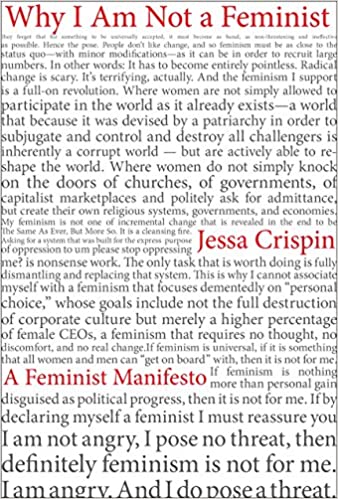
Jessa Crispin’s book is a provocative eye-opener with a lot of insights into current social conditions. The title is of course, intentionally misleading. Crispin is a feminist who just doesn’t happen to like a lot of other feminists. But in the end, the book left me unsatisfied because of the lack of any action plan or suggested remedies for the problems she describes.
Crispin starts off with a hefty list of criticisms of current-day feminism, including claims that:
-There has been a focus on getting women into highly paid professional jobs, such as doctors and lawyers, which (she claims) does nothing for the vast bulk of women (pp. 26-30). Above a certain income level, she says, most women can solve their own problems with money, and lose interest in helping women further down the income ladder. Personally I think this a rather broad generalisation. Many people with high income and qualifications donate time to help others, such as lawyers who take pro-bono cases (i.e. do free work) for social causes.
-Western feminists are unconcerned with, or downright condescending and hostile to the things that are important to women in non-western countries, such as hijabs and other cultural traditions (p. 35).
-Some feminists have claimed that whatever a woman chooses, it’s a feminist choice, because feminism is about women having choices. To take a hypothetical example, if you choose to paint your toenails green, it’s a feminist choice, just because it’s a choice. This means (she says) that you can call yourself a feminist, and your actions feminist, with no real intellectual effort to them, and despite your actions posing no threat to the existing social order (p. 19, p. 44).
-“Self empowerment” (she says) is another word for narcissism.
-Feminists have adopted money as a measure of value, and hence applaud women getting into highly paid CEO jobs, despite this doing nothing to change the economic system as a whole. Women with good jobs can now buy their way out of the effects of patriarchy, and in effect, become part of the patriarchy (pp. 55-60). “We have replaced gender and race with money and power; you can buy your position in society rather than be born with the right genetics.” (p. 58) “Women are now active participants in this system and they are benefiting from it.” (p. 55)
-There is a campaign by many feminists to erase radicals like Andrea Dworkin from feminist history, and to make feminism “acceptable” to people who are not attracted to it. The result (she claims) is a bland mishmash of non-threatening pap (pp. 18-20).
-The demonising of other groups serves the principle purpose of protecting the in-group from having to face up to unpleasant aspects of themselves. Atheists can abuse religious people for being irrational (and thus not face up to their own emotionality in other parts of their lives). Americans can demonise Europeans for being weak and unimportant (and thus not face up to America’s lack of success in some matters), women can demonise men for being violent, so as not to have to look at those qualities, and their own capacity to do harm to others, in themselves (pp. 73-78). I find the idea that the principle purpose of attacks on out-groups is to avoid self-reflection intriguing. I’ve always viewed attacks on out groups as a mechanism for creating in group solidarity, rather than a means to avoid self reflection. I may have been wrong on this.
-Current internet culture, she says, in which minor disagreements are turned into “attacks” and calls for people to be dismissed from their jobs make debating ideas extraordinarily difficult. “Revenge has become an official part of feminist policy… the longer we stay trapped in this destructive dynamic, the less we are using our energy for something constructive… It’s a convenient outlet, outrage. We use it to avoid the hard work of self-examination.” (pp. 97-98). She criticises feminists who attack other people for using the “wrong vocabulary” when the “right” vocabulary keeps changing every couple of years (p.13).
– As women get into positions of power, society is not fundamentally changing, because most women (she says) are not fundamentally morally better than most men. Women judges jail innocent minority men and poor women just like male judges (p. 57), and “support institutional racism.” This is sometimes an unfair criticism. It’s juries who decide guilt in most criminal cases, and judges are required (at least in Australia) to follow certain sentencing guidelines, when setting jail terms. These guidelines exists to ensure some degree of consistency in sentencing between similar cases, and the gender of the judge should not be a factor in the sentencing.
Crispin’s attitude to men with questions is essentially “piss off”. I don’t have to explain anything to you, don’t email me or ask me questions, and don’t ask your female friends to explain feminist issues to you. Do the work yourselves. On this issue she adopts a slightly similar (but more far extreme) position as the Australian feminist Clementine Ford. (Ford at least holds panel discussions with male guests about the nature of masculinity.) Crispin’s attitude, I think, is counterproductive. Many changes that women have sought over the last 40 years have required legislation. In order to get this, male politicians had to be persuaded to change laws. Male lawyers (initially, they would have been male) in government departments had to draft the text of the proposed anti-discrimination legislation. Male heads of large companies and government departments had to agree to change institutional practices to make workplaces more friendly, (although many workplaces have a long way to go). For feminists to make progress they need to bring some proportion – not all, but some proportion – of the male population with them. In Australia, an average of one woman a week is murdered by her own partner, often just after she leaves him. The problem of domestic violence cannot be fixed without changing the attitudes of men. Telling men to piss off and figure it out by themselves doesn’t seem like a clever tactic. I have a standing monthly bank donation to an organisation that assists women leaving domestic violence, and I and another ex-Victorian Treasury officer and I have done some statistics based reasearch for a major women’s organisation, but I avoid engaging with people online on any gender-related issue online because of attitudes like this. These are the only people of whom I can say, “I agree with your policy objectives, and I’ll donate to your causes, but I just don’t want to interact with you online.” If I need to discuss some gender related issue that’s new to me, I only do it with women I’ve known face to face for a couple of years. Gender, immigration and the links between politics and religion seem to bring out the worst in online conversations. Others have told me social media like Facebook or forums like substack just aren’t suited to nuanced discussions of contentious issues, and they may be right.
It also seems odd that the book contains no discussion of sexual harassment in the work place or male violence in the home. Given the lag between writing and publishing, the text may have been finalized in 2016. #Metoo began in October 2017, so I can’t expect the author to deal with that specific movement. But these are very odd omissions. My reaction here is probably influenced by the fact that I read the book the week that there had been a case in Australia of a father murdering his three children by dousing them in petrol and setting them on fire in their car, and then killing his separated wife.
Her criticisms of other feminists remind me of a perennial problem in the left: that many people on the left hate each other more than they hate their supposed conservative enemies. (When I was in the ALP 30 years ago, it was a common jokey observation that a factionally committed person often hated the person sitting next to him or her at a branch meeting more than they hated the conservatives.) Conservatives – especially in the US – seem to be able to band together to resist change, or push their own agendas, far more effectively than people on the left can band together to promote change. Finally, Crispin’s book ends with no clear program about what needs to be done next: say the three to five most important goals that feminists should focus on over the next ten years. She talks about the need to ‘tear down the system,’ with no advice as to exactly how this is to be done or what the replacement will look like. It’s an interesting book, but in the end, it reminds me of Karl Marx’s Communist Manifesto; a lot of denunciation of the existing system, with no description of what the replacement should actually look like.
Richard Snow
18 October 2020
New article on why the US can probably never be invaded
I’ve just added a new article to “New International” magazine on why the US could never be invaded. The reasons may not be what you think:
https://newinternational.net/2018/04/02/could-the-us-ever-be-invaded/
Are social connections a form of corruption in China?
Interesting article hear by DR Michael Baron, who obtained his PHD at Curtain University and now lectures in Businessat Charles Sturt University on how he believes westerners misunderand the use of ‘social connections” in China.
New online magazine launched
I have launched a new online magazine, New International Weekly, with articles on:
 The dynamics of modern sea piracy
 Australia’s tortured path to same-sex marriage

How is Japan reacting to the rise of China?

Will Japan renounce its pacifist constitution?
test
Where Does Moral Thinking Come From?
Jonathan Haidt tackles a big question in his book ‘The Righteous Mind.’ Haidt, a psychology professor who has done stints as a speech writer for democratic politicians, looks at why democrat and republican voters in the US seem never to agree on almost any moral issue.
 After doing extensive opinion polling and interviewing voters to get their reactions to hypothetical moral situations, he finds that people seem to take five factors into account in forming moral judgements. These are: (i) Is anyone injured by an action? People generally avoid doing harm to others, and see it as wrong. (ii) Fairness. – not cheating, not taking more than you are entitled to. (iii) Loyalty to a group. This comes from our early origins as tribal creatures. People who show disloyalty to organisations, sporting teams, the army or their country are often condemned. (iv) Respect for legitimate authority. (v) Showing respect for ‘sacred’ objects, such as national flags, or religious objects, and avoiding ‘dirty’ or contaminated things. A person who places a lot of weight on this factor will disapprove of burning national flags, and, for example, disapprove of the photograph ‘piss Christ’, by Andres Serrano, which shows a crucifix in a jar of urine. More details are available here here here.
Interestingly, when Haidt asks American voters to rate themselves on a seven point scale where 1 represents a very liberal (in the American sense of progressive or democratic voter ) and 7 represents very conservative, he finds an interesting result. Voters who rate themselves as 1 on that scale use criteria (i) and (ii) in their reasoning, but give almost no weight to the other three. And as you move across the political spectrum, the emphasis on the last three factors rises steadily People who rate themselves as very conservative give all five factors roughly equal weight.
Some of this jells with other things I’ve read elsewhere. For example, conservatives are usually strongly opposed to pardons to people like Chelsea Manning who leaked documents from the army. This relates to criteria of loyalty and respect for authority. I’ve read that having strong reactions of disgust at photographs of ‘unclean’ objects such as meat with maggots, or a person treading in dog poo is a strong predictor of voting conservative – this relates to the criteria about avoiding things that are seen as disgusting.
Haidt claims one reason why democrat politicians fail to appeal to conservative voters is that their speeches and advertisements only ever appeal to criteria (i) and (ii), and leave out the other two. He tried to persuade democrat politicians to include more of the last three factors in their speeches, with limited success. Progressive and conservative voters are, in a very real sense, speaking a different languages.
Haidt also discusses the role of religions in moral thinking. He believes they act as reinforcers of moral values by giving a stamp of approval to rules that promote social cohesion, such as don’t kill, don’t steal, don’t lie or cheat, or commit adultery, and so on. All societies have these rules, because you need them to keep harmony ain a primitive society that relies on group harmony to be able to function. All religions promote these rules because in Haidts view, that’s what religions are for.
It’s an interesting read, and I strongly recommend it.
 Richard Snow Writer