Tag Archives: Richard Snow Writer

The Internship: good fun, worth seeing

The Internship: funny movie, well worth seeing

Rose Byrne
Rose Byrne

Last night I went to see The Internship, staring Owen Wilson, Vince Vaughn and Rose Byrne. It’s a classic “fish out of water” story, where the fish makes good against the odds. Two middle-aged guys who know less about technology than the average seven-year-old get an internship at Google because they’ve run out of other job prospects. (The process of getting in seems a little like the way Reece Witherspoon got into Harvard in Legally Blond.) They find themselves with a bunch of twenty year old who can program in C++ and half a dozen languages I didn’t recognize. When asked to design an app, they suggest with something that already exists, and which is already known to all the twenty-somethings. Along the way, they have conflicts with another group of interns who are out to spoil their chances. A love interest arrives half way through the film (like all good Hollywood scripts). In this case she’s supposed to be Australian and she actually is. (Too many ‘Australians’ in American movies are British actors who can only do a half-plausible accent.) The film had a lot of good comedy lines, and they play the tech-newbie aspects of the Owen Wilson for all it’s worth. It’s a good film. You’ll probably like it. Take a night off and go.

Yossarian slept here: when your father betrays you

Catch-22, original book cover, from Wikimedia

Would you feel betrayed by this? Imagine that your father, a famous author, wrote a novel that was clearly based directly on your own family, that it was negative in tone, that it described all his dissatisfaction with his wife, and that he included slabs of conversation that you (the daughter) actually had with your father.

That’s what Joseph Heller, author of Catch-22, did in his novel Something Happened. Heller worked on the novel for 13 years. When his daughter read the proof, she was shocked.  In the book, the writer talks about his unnamed family members, recounting their faults, and how unhappy he was with them all. He talks about his efforts to intellectually out-fox his daughter. One chapter was entitled, ‘My Daughter is Unhappy’. His daughter, Erica asks, “was this a statement or a goal?”  When she asks him why he’s done this, he replies, “What makes you think you’re interesting enough to write about?” What more devastating retort could a father make to his daughter?

In addition, Heller had an affair, which involved flying his lover in the same plane as he and his wife when they went to speaking engagements, and booking the lover into the same hotels. Yes, that’s right- he was carrying on with the lover under the same roof as his wife. When his wife Shirley employed a private detective agency and confronted him with documentary evidence such as credit card bills and photographs, he denied it, and told the rest of his family that Shirley was going crazy and needed a psychiatrist. When Heller was in hospital, Erica walked in on the lover at her father’s bed. Heller calmly introduced them. (The daughter by this time already knew the lover’s name and what she looked like.) After that, Heller reverted to denying the person ever existed. This is strange behavior indeed.

The book gives an insight into what Heller was like as a person, and the answer is, ‘not very  nice, really.’ Still, the book is an insight into one of the twentieth century’s best-known writers. It’s well worth reading. Just be prepared to have some illusions shattered. Geniuses can be petulant, vicious and vindictive in their family affairs.

On another note , my novel, Fire Damage, a terrorism thriller, is now available as a paperback, here. It’s also available as a Kindle on Amazon US and UK. It’s based on the real-life Japanese religious cult, Aum Shinrikyo, which released sarin nerve gas in the Tokyo subway system. 

Zero Dark Thirty: a hard film to review

Zero Dark Thirty is a hard film to review. It deals with an important issue in recent US history. It’s well photographed, the settings are realistic, and some of the details are technically interesting. But most of the characters are not very likable  and there has been a lot of controversy over its depiction of torture.

Zero Dark Thirty movie poster from Wikipedia

One of the films major flaws is the lack of likable characters. The female lead, Maya (Jessica Chastain), is single-minded and dogmatic. Being obstinate and dogmatic can be a good thing when you’re right, but a bad thing when you’re wrong. Fortunately for her, luck – and some clever guess work – were on her side. But the viewer doesn’t feel a great deal of empathy for her. She appears to have no friends, no contact with any family (if she has one)  and no activities outside of her work.

The most likable character in the film was Maya’s fellow officer Jessica, who was killed as she waited to meet a terrorist who had supposedly agree to work with the US. As the terrorist and his driver arrive, they blow up their car. (This based a on a real incident in  2009 at Camp Chapman.)

The photography is excellent. The film does convey  the sense of isolation the Americans must have felt working in these remote, fortified dust bowls. The settings looks realistic: parts of the film were made in India, with certain buildings altered to make them look as though they were filmed in Pakistan.

The tension builds throughout the film as we are shown the bombings in London  and  Madrid, which give a sense of the pressure the main characters must have felt as they tried to find clues to the next likely terrorist attack against the world.

The film implies that torture helped capture bin Laden. The clam that usable information was actually obtained by torture is disputed by many politicians and intelligence officers. Here’s a section from Wikipedia quoting several senior US officials disagreeing about the usefulness of torture:

“In 2012, after three years investigating the CIA’s interrogation program, several officials, including U.S. Senators Dianne Feinstein and Carl Levin, the chairmen of the Senate Intelligence and the Senate Armed Services Committees, respectively, have said that claims that critical information has been obtained through waterboarding are untrue.  But, Leon Panetta, Secretary of Defense, said in February 2013 that critical information was obtained through waterboarding. U.S. Senator John McCain, who was tortured during his time as a prisoner of war in North Vietnam, said upon watching the film that it left him sick — “because it’s wrong.” In a speech in the Senate, he said that, “Not only did the use of enhanced interrogation techniques on Khalid Sheikh Mohammed not provide us with key leads on bin Laden’s courier, Abu Ahmed, it actually produced false and misleading information.”

It’s hard to say if the film should have included torture scenes or not. If they had been not shown, the producers would have been accused of “whitewashing history.” As it is, they have been accused of producing a film that justifies torture. The problem with torture is that once you say ‘yes’ to using torture on a known terrorist to get details of a the next possible attack, where do you stop? What about the guy who is a strong suspect? A weak ‘possible’ suspect? A guy who you don’t think is a terrorists but who knows something about people who may be? And if ‘yes’ to terrorists, would you torture a serial killer suspect like Ted Bundy, while he was still only a suspect? And after that, who?

Overall, the film well made, well acted, and has been nominated for several Oscars. If it wins, the controversy about its depiction of torture will flair again. Is it a “must see” film? No. For all the interesting detail about how bin Laden was tracked down, the film remains a technically well-made film about a group of people it’s just hard to like.

So, has anyone seen the film? What did you think?

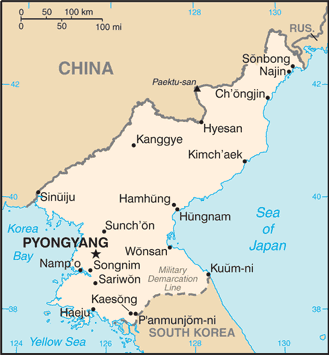
Would North Korea really fire a missile at the US?

This week North Korea had a mental spasm. They decided to test anther long-range missile, and said it was aimed at the United States. Some Americans I know got very concerned. Could the North Koreans really attack the US?

How North Korea behaves
Map of North Korea from CIA Fact BookNorth Korea spends about 40 per cent of its GDP on military expenditure, while the common people are impoverished. It has enriched uranium, and conducted underground nuclear tests. Every time the North Koreans chuck a mental, a six-country conference meets to hammer out the problem: the US, China, Russia, North Korea, South Korea and Japan.  Often they provide food aid and oil to North Korea, in exchange for them scaling back their nuclear programs. The US has frozen and unfrozen various assets of North Korea abroad, as North Korea has cooperated or not with international pressure to cease their nuclear program.

North Korea, China, and the US

I’m speaking now as an ex-economist  of 25 years, who is now studying politics part-time. It’s a current belief among economist and people involved in political science that major trading partners don’t tend to go to war with each other, since the outcome is bad for both of them. It’s like cutting of you own nose to teach your face a lesson. Both parties lose. This was part of the principle between the integration of the French and German coal, iron and steel industries at the end of WWII, which ultimately lead to the free trade zone in Europe.

China is North Korea’s major financial benefactor.  Although the US is concerned about China’s build-up of fleet, (e.g., a Chinese aircraft carrier on the way), China and the US are becoming more economically linked to each other and are developing a “Siamese twin” relationship. The US imports a lot from China, and the Chinese hold about one and a half trillion dollars’ worth of US government bonds (about 11 per cent of the total.) The Chinese don’t want the value of their US government bonds to be degraded, (which seemed possible during the debt ceiling debate of 2012,) and which would happen in a new US war, since any new war  would lead to even bigger budget deficits than the US already has, and lower the value of their bonds. Strange as it may sound, the Chinese want the Americans to fix their budget problems, and said so during the debt-ceiling crisis. At the same time, the US needs to keep importing manufactured goods from China, since they would be more costly if made in the US. China doesn’t want an armed conflict with the US over Korea.

But what happens if the North Koreans really were to make a strike at the US? If the North Koreans provoked the US to the point where the US took some type of military action against them say— airstrikes on their military facilities—this might destabilize the regime, and the results could be anybody’s guess.

It’s not in China’s interest for there to be a major armed conflict between the US and North Korea. If there were major destruction in N. Korea, China would probably get a major influx of North Korean refugees, which they presumably wouldn’t want.

If the North Korean state collapsed, the re-unified Korea would probably be allied with the US, which China also wouldn’t want.

At the same time, South Korea wouldn’t want a disorderly disintegration of North Korea, since some sectors of the North Korean Military may not be under anyone’s direct control while that happens.

Japan

Some refugees may end up in South Korea, or Japan. The Japanese sure as hell don’t want North Korean refugees. In the 1980s and 90s, there was a major political tension between North Korea and Japan. The North Koreans had been kidnapping Japanese citizens off isolated beaches, and taking them to North Korea to teach Japanese language and customs to North Korean spies. North Korea denied it. The issue helped destroy the career of Takako Doi, the first female head of a Japanese political party, (the Socialists). Doi nailed her colors to mast in defending the North Koreans and supporting their denials of these accusations. When North Korea finally confessed it did have kidnapped Japanese in North Korea, Doi’s career was severely damaged. Japan doesn’t really like the Chinese and Korean minorities they already have, and they wouldn’t want any more.

Russia

Last I heard, Russia was building a railway line from Khasan in Siberia to the North Korean port of Rajin, to export more easily to counties around Korea. Therefore, the Russians wouldn’t want a conflict between the US and North Korea, or the disintegration of the North Korean state, since it would mess up their nice new trade corridor.

So what’s stopping a war?

The North Koreans know that if they behave provocatively every so often, then promise to be good, other countries give them oil and food for a while. Then they go back on their promises and do it all again.  But there are powerful forces around them who are likely to hold them back from committing suicide by attacking the US. No one wants the chaos the refugees and the possible military realignment that would follow if North Korea collapsed. I suspect that North Korea knows this, which probably gives them some feeling of safety: while their government is reprehensible, too many people have a stake in it not collapsing. This kind of gives the North Korean leadership a licence to behave provocatively up to a point, without fear of consequences.

All up, I think North Korea may talk crazy from time to time, but there are powerful forces that would keep their behavior in check. I doubt they are really going to fire a missile at the US. It might be the end of their food and oil aid.

So, have any of you got any impressions of North Korea? Has anyone lived in South Korea or China and heard this topic discussed? Did you hear about their threat to fire a missile at the US? What do you think?

Crazy Japanese religious cults: how I got the idea for my first book

Today I thought about why I used the Japanese religious cult “Aum Shinrikyo” as the starting point for my first novel. My ex-wife and I stopped in Japan on our way back from Europe in 1985, and we visited Tokyo, Kyoto and Hiroshima. I loved the place. The train system was fantastic, the country was full of old temples with beautiful architecture, and it was easy to get around even though we didn’t know the language.

Kyoto in autumn, from Wikimedia Commons by Wikimedia user  FG2
Kyoto in autumn, from Wikimedia Commons by Wikimedia user FG2

In between about 1988 and 1997 l learned Japanese on-and-off in evening classes. My ex- and I started home-hosting Japanese visitors and Japanese students from nearby La Trobe University. In 1989 and in 1994, I visited again, only this time on my own. I stayed with Japanese friends.

The year after my 1994 visit, the Japanese religious cult Aum Shinrikyo released Sarin nerve gas in the Tokyo subway system. This event was a major shock to the Japanese people. They were not used to domestic terrorist groups engaging in mass killings in Japan. Soon everyone wanted to know: who are these people? The name Aum Shinrikyo means “Supreme Truth.” Their leader, Shoko Asahara, preached a mixture of Yoga, Christianity, Buddhism, and Nostradamus. He believed the end of the world was near. Don’t they all? He declared himself to be Jesus Christ. He used LSD and electric shock therapy on the group’s followers. Some were murdered.  Shoko was also big on conspiracy theories involving the Freemasons, the British Royal Family and the Jewish people. Yep, they were crazy as batshit. But the group had made a point of enrolling students from some of Japan’s top universities. They promoted themselves as the religion for the intellectual elite. After the gas attacks, Shoko and many of his followers were arrested.

When I stated my novel in the mid-1990s, I had a vague idea about a religious group mounting an attack on something in Australia. I asked: what if some of Shoko’s followers evaded arrest, invented a genetically modified virus, and threaten to release it at an international sporting event in Melbourne Australia. I invented a mini-Olympic Games that I called the “Pacific Games.” Setting the book in my own city seemed a pretty obvious thing to do. I could write scenes in Melbourne, and I had learned enough about Aum to visualize what they would do.

Sometimes I look at other writers and ask, “How did they get their idea?” How did Philip Hose Farmer get the idea to write Jesus  on Mars? (You guessed it: Earth detects some ancient Greek letters carved on a doorway into a mountain on Mars. They go inside and who do they find? Jesus and a bunch of guys following first century Judaism. I won’t spoil the plot.)

So, what’s the most unusual story idea you’ve seen in a book, and where do you think it came from?

I’d love to hear from you.

Note: this is my blog site.   For information about editing an academic thesis, click here.

My novel Fire Damage, an action thriller, is available on Amazon Kindle, here : the novel is based on the Japanese religious cult Aum Shinrikyo, which released Sarin nerve gas in the Tokyo subway system in the 1990s. If you don’t have a Kindle, you can download the app to read it on your computer or phone from here. For the paperback version, click here.

Should you be allowed to name your kid Adolph Hitler?

According to media stories,  a couple have named their baby girl, born 24 November 2012,  “Hashtag Jameson.”  The media stories about this are mostly British, so I’m guessing the baby was born there.  An Egyptian man has supposedly named his baby “Facebook” in memory of the role Facebook played in mobilizing people  in the revolution that overview the Mubarak regime last February. And in the 2005 book “Freakonomics,” Steven Levitt told of an American couple who allegedly named their kids Orangejello and Lemonjello.

Adolph Hitler – from Wikimedia Commons

Others have disputed that these children ever existed. Levitt’s study of how names move around America suggests that names start off in affluent areas gradually “trickle down” to become popular in the middle class, like Madison. But one LA Times  writer several years ago pointed out an academic study showing that the more unusual a child’s name, the more likely they were to end up in the juvenile justice system. It may not be the name that does it, tho.  The lower the educational and social status of the parents, the more likely they are to give their kids strange names.  And lower socioeconomic groups are over represented in the crime statistics.

Last year, a New Jersey couple who named  one child Adolph Hitler , and another Aryan Nation,  had all three of their children taken off them, immediately after the birth of the third. The authorities say it’s because of child abuse and violence, but the couple say it’s because of the names.

So what do people think? Do parents have a right to name their kid anything they like? Does the state have a right to protect a child from ridicule and abuse that it may get from having an offensive or ridiculous name? Does it have a right to prevent parents from giving the child a name that would offend many people (like Hitler).  Does a child have a right not to have a name that exposes them to ridicule or abuse, and if so, who sticks up for the child?

I’d love to hear what you think.

Note: this is my blog site. For information about my novel, click here. For information about editing an academic thesis, click here.

Odd stuff I found in the papers this week.

In Britain, a young woman has had her stomach removed after drinking a cocktail made with liquid nitrogen. Gaby Scanian, 18, a resident of Haysham in Lancashire, drank the cocktail at Oscars Bar in Lancaster. The bar had advertised the drink on its Facebook page.  Adding liquid nitrogen to the cocktail makes it give off white smoke. Liquid nitrogen is often used to chill food and glasses, but if swallowed may burn your mouth, throat, and stomach. The bar has since stopped serving the drink.

Cocktail Picture by Lynn Kelley Author, WANA Commons

Scientist have discovered a new type of squid, named  Vampyroteuthis infernalis, (Latin for  “Vampire squid from Hell”).  The squid lives at ocean depths so low that it can’t form muscle tissue, so it lives on  dead things, and guess what else? Faeces. Yep, that’s right. Apparently this doesn’t require a whole lot of muscle development.

Some squid that live in the waters around the states of Victoria and Tasmania, Australia, use up so much energy in mating that they swim slower for half an hour afterwards. The “dumpling squid” only live a year, and become sexually mature at four months, so they have to get it while they can. Melbourne University Master of Science student Amanda Franklin studied the squid and published  her findings in the Journal “Biology Letters.” According to Franklin, the squid have multiple partners and the males initiate sex “whenever they can.” Being slow to swim afterwards makes them vulnerable to predators, so they bury themselves in sand to hide.

A bride in the town of Jallias  in western France gave birth to a baby, only minutes after the wedding  ceremony. She was not due for a week, but felt unwell after a ceremony at the town hall and went back inside. Minutes later paramedics were called after her waters broke. The local mayor, Jean-Robert Gachet, said it was a very emotional moment for everyone when the baby was delivered. Yeah. sounds like bad planning to me. I wonder what the wedding photos will look like.

If anyone would like to alert me to weird stuff in their newspapers, please let me know.

ON A MORE SERIOUS NOTE: There has been a lot of discussion this last couple of weeks about the film “Innocence of the Muslims,” and the resulting riots in many counties, including at least a couple of dozen people who have been killed. I found this video by a Muslim man, Syed Mahmoud, urging his fellow Muslims not to demonstrate or riot. I agree. The film is an artless piece of junk that looks as tho a-14 year-old made it just to be provocative and seek attention. Mahmoud argues that by continuing to demonstrate, people are simply giving the film free publicity, for no good outcome. I agree, and   here’s the link to his video.

Have a good week.

Richard Snow

My novel ‘Fire Damage,’ an action thriller, is available on Amazon Kindle, here :The novel is based on the Japanese religious cult Aum Shinrikyo, which released Sarin nerve gas in the Tokyo subway system in the 1990s. If you don’t have a Kindle, you can download the app to read it on your computer or phone from here.

The world is getting stranger: what do chess games have in common with assault rifles?

Chess players with assault rifles? Sounds unlikely, doesn’t it? But first some other strange news:

A consumer agency in the US filed a law suit to ban the sale of “Bucky balls” (shapes that fit together with the aid of magnets inside them.) A total of twenty-two children had swallowed the magnets and suffered an injury, out of a total of 475 million magnets sold. Someone did a  bit of mathematics, and calculated the rate of injuries per 100,000 people from Bucky balls, tennis, skate boarding, and dog bites. Guess what’s most likely to give you an injury that needs medical attention? Guess first. I’ll tell you at the end of this blog.

In Australia, a youth on the run from the police decided to hide in the roof cavity of a house when the police came to a party. He should have stayed still, because when the moved, he fell through the ceiling, and into the long arms of the law. I’m sure the cops were surprised too.

Can you imagine chess players with  assault rifles? Neither can I. But it turns out that the Sicilian Defence, one of the most common chess openings, has a variation called the  Kalashnikov variation  What the Hell?? Well, the AK47 weapon was named after an Mikhail Kalashnikov, who invented it in 1947. Chess openings, as it happens, are often named after the city where they were first successfully used in an international tournament, or the player who made them famous by coming up with a new twist and winning unexpectedly. But the various chess websites and books I’ve consulted have no information as to which Mr Kalashnikov started the chess move. His first name appears lost to history.

AK 47 (photo from Wikipedia Commons)

And what about the Buckey balls? It turns out that tennis is more likely to cause you an injury than skateboarding, dog bites, accidental poisoning with household substances, and Buckey balls come last.    Click here for the stats.

A stranger in a strange land: my strangest experience in a foreign country.

This week, a post in Piper Bayard’s blog about Russian naval spying bought back a memory of perhaps the strangest experience I ever had as a tourist. In 1985, I visited the USSR, as Russia and it satellite countries were then called. In those days, Russia had strict currency exchange control laws. The Rouble was tied to the British pound at one for one. But, on the streets, one British Pound could get ten Roubles.

Red Square – from Wikipedia commons

The Russian authorities wanted to control street speculation: they wanted all the foreign “hard currencies” to go to the state, not to private individuals. How they achieved this was unbelievable.

On the train going into Russia from Finland, the dining car took western currencies. Shortly before we crossed the border, the waiters stopped taking new orders, and went to balance the cash register. When we crossed the border, we pulled up at a train station where we were all encouraged to get out of the train, and changed our foreign money into Roubles. I had Deutschmarks (the German currency before the euro.) I changed my money, bought something in roubles, and a few hours later we arrived in Leningrad (now called St Petersburg). In between, I saw what the waiters were going. They were balancing the tills in different western currencies, before they changed to operate  in Roubles. It dawned on me. The waiters were not allowed to handle Roubles and western currencies at the same time. If they did, a customer would pay with a British Pound, the waiter could put a Rouble from his own pocket in the till, then sell the British Pound on the street for ten roubles. The waiter would get the benefit of the Pound, not the state.

After checking into my hotel, the problems began.

The hotel had two bars: a Rouble bar, for visitors from communist countries, and a western currency bar for types like me. I made the mistake of going into the Rouble bar and trying to order a drink. The waiter point-blank refused to serve me. He pointed up the corridor  the corridor to the western bar. I went. In the western bar, I tried to order a drink. But the barman wouldn’t serve me there either. I had my money in hundred Deutschmark travellers’ checks. He could only take real money: Deutschmark paper money. He told me to go to the gift shop. They would take my travellers cheques and give me Deutschmark paper money in change. Up to the souvenir shop. Yes said the woman, she could take my travellers cheques and give me change. BUT, only if I bought 85 marks worth of souvenirs, and then she would give me fifteen marks of change.

WHAT?

I have to buy 85 marks of tourist photo books and grandmother dolls to get fifteen marks of change to buy a drink?? I’M GOING TO BE IN RUSSIA FOR TEN DAYS!! THIS IS A FINANCIAL DISASTER! HOW AM I SUPPOSED TO PAY FOR FOOD?

Down to the hotel foyer. They tell me to go to the bank opposite. I do. The bank teller will cash my 100-Deutschmark notes into Roubles. Not Deutschmark paper money, just Roubles. That’s no help.

Back to the hotel.

I’m grinding my teeth into dis-existence with this frustration.

A Finish woman asks me what’s wrong. “Didn’t you know?” she asks. “When you come to Russia, you must bring many small paper monies. US one and five Dollars, one, five or ten Deutschmarks, or one and five British pounds?”

“No. No one told me.”

I go to the hotel counter again. This time a woman tells me to go to the desk which sells opera and ballet tickets. The woman there can take my travellers checks and give me Deutschmark change. Hallelujah! I buy an opera ticket for that night. Who cares what the opera is? Not me. It turns out to be something about drunken priests in a monastery, but I can’t follow the plot. I have change. The whole process of being given the run-around has taken about three hours. Seriously.

The next day I meet an American couple from Chevy Chase. I explain my problem and ask if they want to see any opera or ballet. Yes. Could I buy their tickets for them? Yes. We go to the desk and find out the price in Marks and Dollars. I buy the tickets for them in Deutschmarks, They give me American Dollars for the tickets. Now I have two useable currencies. The woman on the ticket desk watches us, but doesn’t care.  Everyone’s happy.  For the next ten days I become a man of culture.

So what about you? What’s the strangest experience you’ve had in another country?

– – – – – – – – – – – – – – – – – – –

My novel ‘Fire Damage,’ an action thriller, is available on Amazon Kindle, at:
The novel is based on the Japanese religious cult Aum Shinrikyo, which released Sarin nerve gas in the Tokyo subway system in the 1990s. If you don’t have a Kindle, you can download the app to read it on your computer or phone from here:

The world is getting stranger: that piranha ate my kid’s finger!

Here’s a collection of strange things I’ve come across recently.

A family in Chicago thought their pit-bull had eaten one of their daughter’s finger. When the doctors said it wasn’t a dog injury, the father went home, gutted one of the family’s two piranhas and found the finger. Seriously? They have a toddler and a pit-bull and two piranhas?

In Britain, a team at Bristol University  has developed  a chewing gum called Rev7. It’s water soluble and  won’t stick to footpaths (sidewalks).  London Mayor Boris Johnston is strongly in favor. He’s tired of the cost of cleaning gum and other “adhesive” objects off the  streets.

Motorist Flora Burkhart  has been charged in Van Buren, Arkansas, for rear-ending another vehicle and then fleeing the scene of the collision because she didn’t want her ice-cream to melt.

Two cops in New Mexico, Ernest Armijio and Brian Bernal,  aren’t allowed to carry guns  because of their law-breaking history. One because of a dispute over child support arrears, and the other because of domestic violence.

Some things in life are too quaint for words. I learned this week that Britain has a public office called  “Her Majesty’s Inspectorate of Constabulary”. What does it do? Conducts reviews of how well the regional police forces in England and Wales are doing their jobs. But it’s a cute title, isn’t it?

Recently, I came across the Finnish and Russian habit of swimming in frozen, or near-frozen rivers and lakes.   Apparently they punch a hole in the ice and jump in, often wearing ordinary swimwear rather than wetsuits.  How do you stop the ice freezing up again on you? Keep a pump in the water to keep it circulating.

So would anyone else care to contribute  anything odd you’ve come across in papers, on the net, or seen personally? The stranger the better!

– – – – – – – – – – – –

My novel ‘Fire Damage,’ an action thriller, is available on Amazon Kindle, at:
The novel is based on the Japanese religious cult Aum Shinrikyo, which released Sarin nerve gas in the Tokyo subway system in the 1990s.
If you don’t have a Kindle, you can download the app to read it on your computer or phone from here: