All posts by Richard A Snow

I studied Economics at La Trobe University (getting a BEcHons and MEc). I was writing for newspapers, mostly on personal finance, from 1997 to 2006, part-time, while working as an Economist at Victorian Department of Treasury and Finance, and later as an Associate Lecturer at La Trobe university. I have a stock of older, published newspaper articles at http://richardsnownewspaperarticles.wordpress.com

Aayan Hirsi Ali’s “The Caged Virgin”

This isn’t so much a book review as a few thoughts sparked off by Aayan Hirsi Ali’s “The Caged Virgin.” The book is a collection of essays, but Hirsi Ali sums up some of her positions in the preface to the book.

In regard to Islam she says:

(first)  “… a Muslims relationship with God is one of fear.” (p.x)

(second) “… Islam only knows one moral source: the Prophet Muhammad.”  (p.xi)

(third) “…Islam is strongly dominated by a sexual morality derived from Arab values dating from the time the Prophet received his instructions from Allah, a culture in which women were the property of their fathers, brothers uncles , grandfathers or guardians. The essence of a woman is reduced to her hymen…. A man’s reputation and honor depend entirely on the respectable, obedient behaviour of the female members of his family.” (p.xi)

In the opening essay, “Why Can’t We Take a Critical Look at Ourselves?” she says “…we Muslims have religion inculcated in us from birth, and this is one of the very reasons for our falling behind the West in technology finance and health.” (p.7).

Hirsi Ali repeatedly points out the unequal, and sometimes appalling treatment of women in Muslim countries: girls who have been raped getting flogged in addition (p.72), and an alleged 5,000 “honour killings” of girls every year in Muslim countries. (p.12.)

She returns at various points to the claim that Muslim society has fallen behind the west. I do not recall the page, but at some point she makes the claim that the big advances of the last 100 years have come from the west. She does not explicitly name them, but she might be thinking of things like air travel, immunisation, television, organ transplants, the internet, or many other technological advances. (One might add that some of the blights on modern society like fast food, and the processed manufactured gunk that a lot of us eat also came from the west.)

She refers to a United Nations report (Arab Human Development Report, 2002)  (P.45 of her book) in which twenty-two Muslim countries are examined and which comes to the conclusion that “the (Arab)  region  … is plagued by three key deficits that can be considered defining features: a lack of freedom; disempowerment of women; and a lack of capabilities or knowledge.”

Thinking about this set me searching for Muslim responses to Hirsi Ali on the internet. It was hard to find them at first, because the search engines initially throw up Hirsi Ali herself, including many videos of her interviews.

One site I came across was http://answeringchristians.blogspot.com  maintained by a Pakistani woman. This site is not specifically related to Hirsi Ali, but it contains examples of honor killings by Christians and murder by Christians in Ghana who burned a woman to death for being a witch. The site also quotes the old testament verses about raped women becoming the wives of their rapists. The Old Testament contains some very violent passages.

See   http://answeringchristians.blogspot.com/2010_11_01_archive.html  but  you need to scroll down through 6-8 entries.

Another site that does specifically discuss Hirsi Ali’s “Infidel” is http://goatmilkblog.com/2008/04/06/ayaan-hiris-alis-infidel-commentary-by-asma-t-uddin/

It’s hard to summarize his views, but he states that “The drama, deceit, and sensationalism kept me hooked, I guess.” He makes a legitimate point, I think when he points out that Ali never refers to Christian fundamentalists in the US:  “I am not sure where and when she educated herself about Judaism and Christianity, but she seems to have completely overlooked each of these religion’s fundamentalist strains.”

I also found a site that discusses Christian witch hunts in Africa and Papua New Guinea and Hindu witch killings in India: http://www.loonwatch.com/2010/04/witch-hunts/

What I’m Reading: I am Nujood, Aged 10, Divorced.

Book review: I Am Nujood, Aged 10, Divorced.

I don’t know where or how I bought this book. Perhaps, having read Ayaan Hirsi Ali’s account of growing up in Somalia, I was attracted by the title, wondering what life was like for other women in the middle-eastern world. At any rate, the title certainly gets your attention. Since Nujood is only 10 years old, the book is co-authored (or should I say ghost written?) by French journalist Delphine Minoui.

In a nutshell, Nujood grows up in rural Yemen: I confess I had to look it up on a map to discover that it is the country south of Saudi Arabia. If you wanted to go from the Indian Ocean up the red sea to the Suez canal, to the Mediterranean, Yemen would be the first country you passed on your right hand side. Although the legal age of marriage in Yemen is fifteen, her father marries her off at the age of ten. His reasons? That two of her sisters have been kidnapped and that, the family being poor, the marriage of Nujood will mean one les mouth to feed. The husband is about thirty, and takes her virginity on their wedding night, despite having promised to wait until she reached puberty.

The book touches, perhaps unconsciously, on themes that Hirsi Ali deals with, in particular, the way women are taught to be submissive:

“In Khardji, the village where I was born, women are not taught how to make choices.” (p.23)

“Since forever,” writes Nujood, “I have learned to say yes to everything.” (p.18)

After a trip back to her family, she tries to get help from her immediate family, but no one has any advice except her father’s second wife, Dowla, who lives separately to the rest of the family, and who first suggests that she go to court, seek a divorce, and gives her some money to help with the trip. In the court room, after she had told her story to a judge, she attracts the attention of a prominent female lawyer, Shada Nasser.

So what has become of Nujood now? She states: “ I recently left my uncle’s house and returned to live with my parents, because in my country, there are no shelters for girls who are the victims of family violence.” (p.130). The royalties from the book will pay for an education, but Nujood is currently only in second grade. Journalists still come to visit her, and her brother doesn’t like the “shame” all the publicity has brought on the family. I wonder where she’ll be in five years time.

It’s a well written book, and gives an insight into a life most of in the west have no idea about.

Note: this is my blog site. For information about my novel, click here. For information about editing an academic thesis, click here.

Why Did My Taxi Driver Run Away?

7 November 2010

 I didn’t mention it in my posts earlier, but a couple of weeks ago there was gridlock on an intersections near my school. People won’t wait for the intersection to clear before they attempt to cross it. Jumping the lights is a national pastime. I think it ranks number 5, after (1) driving on the wrong side of the road, (2) driving with your headlights off at night, (3) having no helmet, or a helmet without the straps done up, and (4) talking on your cell phone as your steer your motor bike.

 So there was this intersection with nobody going anywhere. Now, jump forward in time: I just had four nights in Bangkok. Thailand is light years ahead of Cambodia economically. There are real motorways, most people have cars, and it makes me wonder how Phnom Penh’s out-of date, ill-repaired road system, will cope in ten years’ time when the traffic (which is ninety per cent motorbikes) turns into a larger number of cars. As incomes begin to rise this city is going to turn from traffic nightmare to traffic hell.

 So: Bangkok: Sunday: On my way into town, the taxi driver turned around in his seat to face a building, put both his hands together in front of his face in something like a little prayer gesture. I asked what the building was and he replied ‘King Number 5’. Now it turns out King Rama V died in 1910, but is credited with steering the country into the 20th century. Reverence for the Monarch is taken very seriously here. At a stage show later in the week everyone was asked to stand while they played the national anthem and showed film clips of the current King.

On Sunday night I went to the Bangkok flower market. It sells beautiful stuff, but I did feel unsafe on the bus system at night. Maybe it’s just my age: but I decided the time to figure out a new city’s transport system is during the day.

Next day was temple seeing: the Royal Palace and the Pagoda of the Emerald Buddha. The emerald Buddha is actually made of jade.  (They made a mistake when they first discovered it: it was encrusted with plaster and they realised there was something else underneath, pulled of the plaster and thought they had a real emerald Buddha.) The architecture is beautiful.

 The Royal Palace and the Palace of the Emerald Buddha are connected by gates so it’s effectively one large complex. My shorts didn’t cover my ankles so they made me hire a new set of pants to wear. Women were made to hire enough shirts and long trousers so as not to have any real skin showing.  BUT they gave you the whole hire fee back at the end. I.e., they didn’t use the hiring to make money. The architecture is beautiful. Pictures will follow when my card reader decides to work again.

On the way back to the hotel the taxi driver feels the urgent call of nature, stops the taxi, tells me to catch another, doesn’t charge me, but bolts to somewhere to relieve himself, leaving the taxi in the middle of the street. I catch another one further up the road. Fortunately the taxis are mostly shades of fluorescent pink, orange or yellow and green so they are hard to miss.

One of the four evenings I end up in a cafe next to two guys, I think one Canadian and one American. They both teach English in Cambodia. The second admits to using a fake degree scroll, because although he went to uni for 6 years he just never graduated. 

Side note: bear in mind there are 14 million Cambodians drinking maybe 2-3 litres of water a day and the bottles vary from 750 mills to 1.5 litres. Nobody drinks the tap water. Rough calculation: 14 million people x 3 bottles a day x 365 days a year = 15 billion bottles a year. This figure can’t possibly be right so someone must be using the village well, but I don’t know who.

 The two guys ask what I think of Phnom Penh. I say I am depressed by the beggars, and the small kids picking through rubbish piles for recyclables late at night. They disagree: the kids are bringing in income to the household, the plastic water bottles need recycling, and the next best alternative is [OK, dear reader: insert your least-disliked expression for the sale of oral sex.] “Because,” they tell me, “that’s the next best alternative.” I feel repulsed. They say it’s not so different to Britain 100 years ago. There were times when kids worked in coal mines. After they quote some statistics about foreign revenue earned by sex workers I tell them the conversation is making me feel more depressed. They change topic. I leave after two cans of coke and get some food elsewhere.

The Hospital that Didn’t Exist

I had breakfast with a French guy who runs an NGO. He’s a Captain in the French Army Reserve. He was telling me how he once arranged a shipping container of medical equipment to go to a supposedly needy hospital in rural Cambodia. Later he tried to visit the hospital. It didn’t exist. So where did the stuff go? Well, I’m not stupid enough to write the most likely answer in this blog while I’m still in the country.  But Transparency International just relaeased its Index of Corruption for 2010. Denmark, New Zealand and Singapore tied for first place a non-corrupt. Cambodia came in at 154 out of 178 countries.

If you want to know more, click on the link below. There’s the actual list and scores and a color-coded map of the world. It will make you think about giving money to some charities and some countries. It’s sad but…

The French Army Captain now insists on accompanying the deliveries himself with his own interpreter.

http://www.transparency.org/policy_research/surveys_indices/cpi/2010/results

Another odd thing about teaching in Cambodia

Another odd thing about teaching in Cambodia:

To appreciate this it helps to know that

  1. Cambodians refer to themselves as “Khmer” and their language as “Khmai”, so Cambodian internet sites end with “.kh”
  2. Cambodians tend to accent the last syllables of words. They abbreviate their names to the last syllables not the first.  If Jonathan were Cambodian he’d be Than, not John.
  3. They have many vowel sounds which are so short I generally can’t hear them, and involve little jaw and lip movement, and therefore:
  4.  When teaching some English words you have to drag out the vowel to triple its normal length and physically show them how to round their lips by pinching your own mouth on the sides with your finger and thumb to emphasise that the lips need to be rounded to get the “ooh” sound. Or put your finger under your chin and make them watch how your finger drops when you say “cup” etc.  Attempts to get the students to imitate this are met with embarrassed laughter and sometimes outright refusal. They find my pronunciation antics highly amusing.
  5. Google exists in Cambodia: the site is www.google.com.kh.  I’ve seen the hotel staff using it. I’ve seen people on it in internet cafes. I know that people know about it. Google defaults to this site unless you put “.co.uk” , “.co.nz” or “.com.au” into the name to force it to the British, New Zealand  or Australian sites. If you look for the American Google site it goes to the .kh site. Even if you Google Google itself, and click the link to the American Google, you end up back on the Cambodian one.
  6. In China, where the internet is censored and sites are blocked, you can’t get Wikipedia, Facebook or Twitter. But you can get them on Cambodia’s version of Google.

SO…

I’m talking about something in the classroom to a bunch of 16-25 year olds  and I suggest if they want to know more about whatever it was they should look it up on Google.

What?

Google, on the internet: how many of you can get to an internet?

 Lots of hands go up.

Well you know Google then? On the internet?

Eyebrows are screwed up, heads are tilted, “what teacher?”

I draw a big rectangle on the board, draw an address bar and write www.google.com.

Howls of laughter.

“No teacher, you say it wrong. It  G’GOL. G’GOL

I do the round lip thing: “Well in English you say Gooooogle.  Try that Goooogle”.

Hysterical laughter. Faces are hidden in books and behind pencil case. Some of them try and the rest collapse laughing.

Tonight they did the end of semester exam. It’s my last day in this university. They had to write sentences with comparative adjectives and the “as adjective as” pattern.

One student has written: “Richard is funnier than my old teacher. He is as funny as a joker.”

Monkey Business

They want what you've got.
Lying in wait for tourists with bags

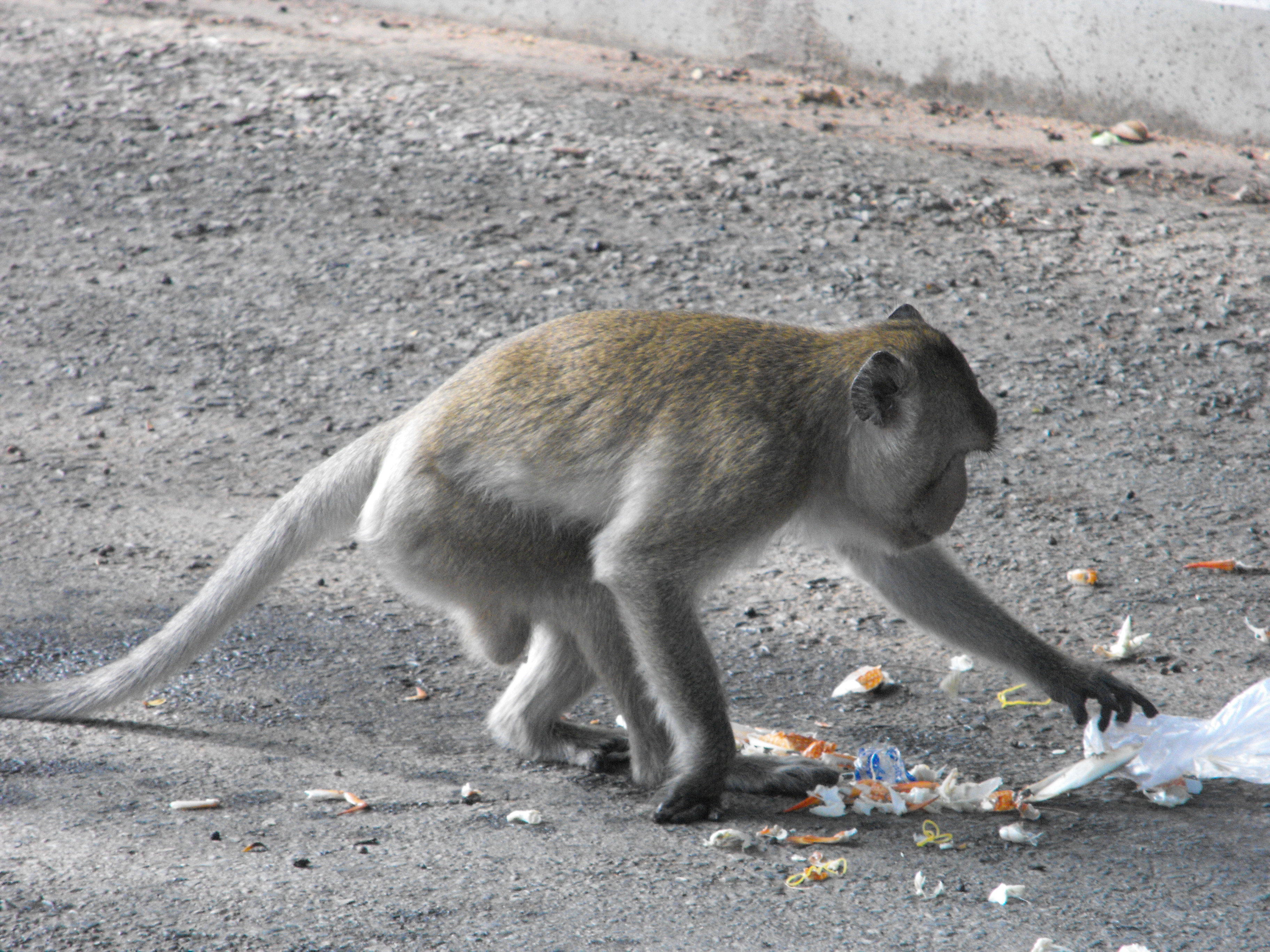
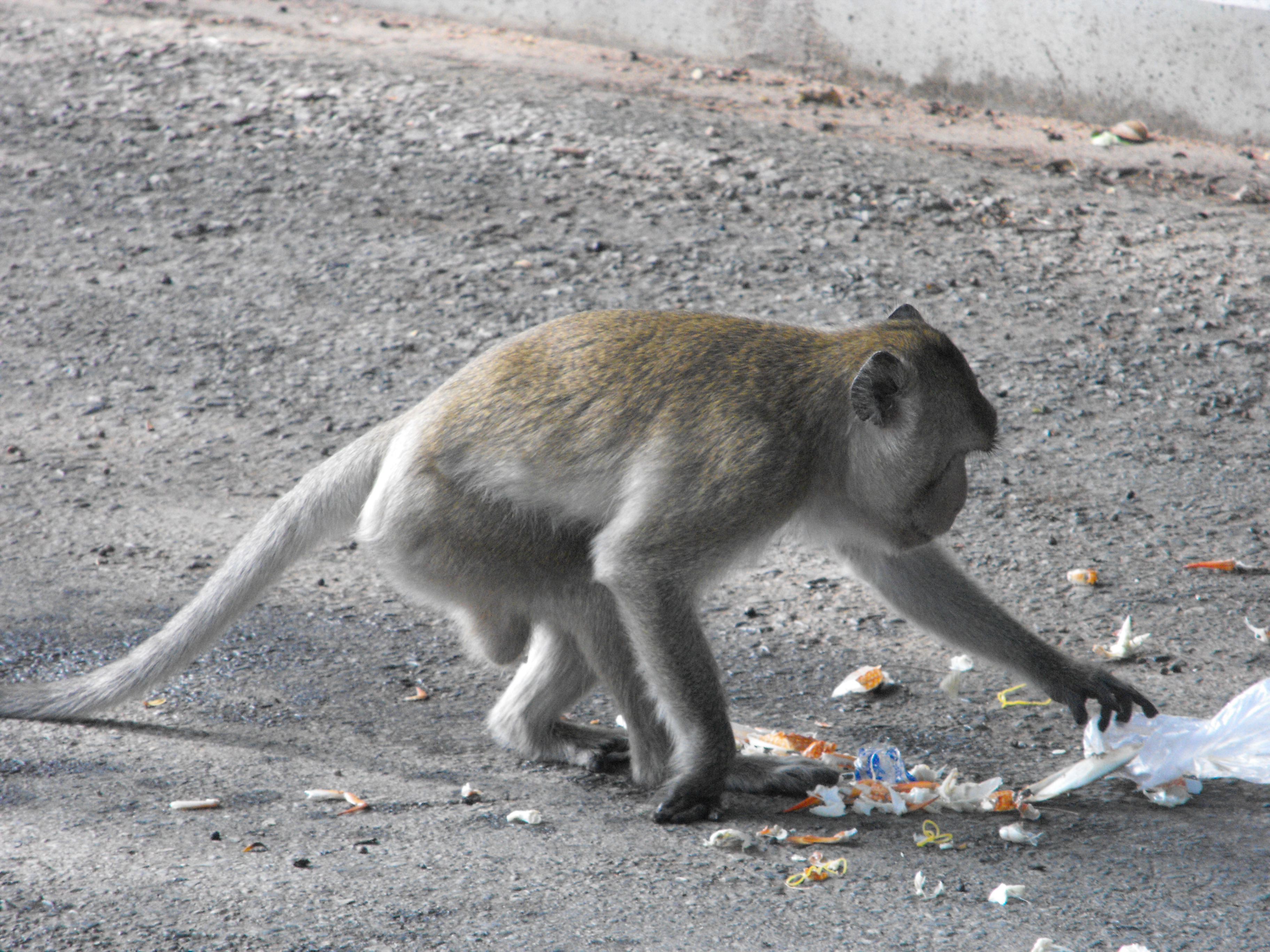
On the weekend I went to a seaside town called Kep. There are lots of monkeys there. they have  yellowy-brown fur with white chests and stomachs, and  they follow tourists around wanting food and trying to snatch bags. One of them, about two foot tall, went straight in front of me opened its mouth and bared its teeth. Fortunately, if you splash some water at them they run away.  I was a bit concerned ‘cos I don’t know if they have diseases that can be transmitted to humans, but

They want your food, or whatever is in that plastic bag.

But all’s well that ends well. I retreated to the safety of a tuk tuk to take some more photos. It seems that the more tourists feed them the more they expect to be fed. The town of kep itself is an odd mixture of things. There are still burnt-out buildings form the 1970s, when the Khmer Rouge hated the town and burnt lot of it down. It had been a playground of the wealthy, and the Khmer being Moaist communists, well… The strange thing is thatnew buildings are being put up while the old ones are left intact as empty shells. I’m having a spare set of glasses made here. The cost is $160. In Australia the same thing might cost me $500 (frames plus lenses.) Here’s to living in a cheap country.