John Rizzo was the second-highest lawyer in the CIA for much of the 1990s and early 200os. On several occasions he was acting chief counsel, when the top job was unfilled. Rizzo’s book Company Man (published by Scribe) describes how the CIA came to use “enhanced interrogation techniques” after the 9/11 attacks.
The first really important capture of an Al Qaeda member after 9/11 was a man named Abu Zubaydah, the head of logistics for future operations against the US. The CIA feared another attack on the US might be immanent, and they needed to get any information out of him. His interrogators found him an “arrogant,… twisted, smug little creep,” (p.182-183) who told them lots of old news, mixed with outright lies. When using standard legal interrogation methods, and ‘playing by the book,’ Zubaydah’s interrogators were getting nowhere, they sought permission to use a series of nine harsher interrogation steps, from slaps to the face, and escalating measures up to water boarding.
Because the CIA had been stung by previous accusations of illegal activities, those in charge of the interrogations wanted to ‘cover their asses’ by getting a CIA lawyer to tell them their proposed methods were legal. That request came to Rizzo, who in turn sought the opinions of the Department of Justice. Every proposed action was described in sometimes ludicrous detail. A slap to the face had to be with an open hand, the fingers splayed and hit below the ear. If he was shoved against a wall, they had to have a fake, flexible wall installed, so that Zubaydah wouldn’t get bone fractures. Further down the list, he might be placed in a small box that forced him to curl up, and then harmless insects would be dropped into the box. “Why?” asked the lawyer “Zubaydah hates bugs,” a CIA official replied. “It will be something harmless, but he won’t know that.” (p.184-185) And so it began.
Lawyers in the DOJ managed to somehow convince themselves that something wasn’t torture unless it resulted in pain associated with “death, organ failure, or serious impairment of body functions.” When the CIA needed to brief the congressional leadership, former POW Senator John Mc Cain sat stony faced and silent, and made a one-sentence comment at the end. “It’s all torture.”
I’ve described above what I consider, from a public interest view, one of the most controversial parts of the book. But much of the book gives an insight into the operational culture of the CIA, and how it changed over time. Covert actions, almost non-existent under President Carter, rose dramatically up under Reagan, and lawyers had to draft a Presidential “Finding” authorizing every last one.
People in the field wanted endless memos from lawyers telling them whether they could legally do various things. Even buying mules to give to the mujaheddin in Afghanistan needed a lawyers approval! ( The mujadeddin were religious muslims fighting the soviet backed government in th 1980s. A field officer had been told he could buy and give material aid to the Mujaheddin, but anything he gave them had to be “non lethal assistance”. The officer wanted to buy mules to help the fighters transport their goods in mountainous territory, but mules are often cranky and uncooperative animals. The officer was afraid that if a mule kicked someone in the head (which they sometimes do) , and they died, or if it kicked someone and knocked them off a narrow mountain ledge, he might get blamed for the death. He needed a lawyer to tell him that mules were considered “non-lethal” because the purpose of a mule was not to kill people. Any such death would be an unexpected and accidental event.)
It’s an interesting book, and I’d recommend it to anyone who has an interest in Guantanamo Bay, how the secret prison system came into existence or the general culture of intelligence organizations.
My attention was caught last week by an article involving a student at Oklahoma Wesleyan University, who felt that he was being victimized by a sermon in the university chapel on 1 Corinthians 13. For those not familiar with it, it’s the chapter of the Bible you often hear quoted at Christian weddings about the importance of love. According to the university president, “It appears that this young scholar felt offended because a homily on love made him feel bad for not showing love. In his mind, the speaker was wrong for making him, and his peers, feel uncomfortable.”
Amherst College Demonstration: Let’s all take a selfie. Credit: Daily Beast.
It’s a long time since I’ve been a religious believer, and I don’t share many of the stated opinions of the university president, (especially when the subsequent radio interview gets to Syrian refugees) but it’s hard to think of a chapter less likely to victimize anyone.
So what’s going on?
Again to quote the university president, ‘“I’m not making this up. Our culture has actually taught our kids to be this self-absorbed and narcissistic. Any time their feelings are hurt, they are the victims. Anyone who dares challenge them and, thus, makes them “feel bad” about themselves, is a “hater,” a “bigot,” an “oppressor,” and a “victimizer.” ’
I had recently read an article about three students at Amherst College in the US going on a hunger strike, demanding that the university college administrators find who had distributed a flyer proclaiming the death of free speech at a different university. (The other university was Ole Miss – the University of Mississippi). Someone was also claimed to have plastered over “Black lives matter” posters at Amherst with anti-abortion and “All lives matter” posters. The students at Amherst want administrators to subject the perpetrators to mandatory sensitivity training. I’m not joking. (Ironically, given the comments above about students being narcissistic and self-absorbed, the Daily Beast’s photograph of the Amherst demonstrations appears to show about a third of the students ether taking selfies or photographing other demonstrators. (See above.)
If there are racial discrimination problems at Ole Miss, they should be investigated and fixed (although Ole Miss seems a historically hard case). Society has fixed a lot of racial discrimination problems over the last fifty years, and the task (sadly) will probably be going on for decades to come. But it’s not like the students at Amherst have no voice. And it’s not as if students haven’t been plastering posters over each other’s posters since before time began. Social media allows almost every group to publicize its views and students have demonstrated over lots of things for as long as I can remember.
But a hunger strike is different. A hunger strike is basically a threat to commit suicide in slow motion. Irish Republican Army prisoners used it against the British in the 1980s. It’s a tactic normally reserved for the gravest of causes. And now a hunger strike is being deployed over the rights or otherwise of someone to distribute a leaflet on one campus about whether free speech is dying on a different campus. And because some other student group stuck a leaflet over the top of yours. Anyone see any irony here?
At the same time, I’m seeing more and more articles, websites and Facebook posts assuming that there are only two sides to any question, and that if you disagree with someone else’s position you must be a bigot or a hater. Expressions like, “You’re just part of the PC brigade,” or “You’re an islamophobe,” or ‘You’re a tree hugger.”I don’t know about you, but on most political religious or other social issues I could generally think of four, five, or six positions that might be possible. For example, I can think of six possible positions on abortion. Right now, I’m just going to rattle them off to illustrate that point. I don’t really care if you agree or disagree with any of them, but here they are:
life begins at fertilization, so even IUDs or the morning after pill are an abortifacient,
life begins at implantation, so IUDs are ok, but abortion after that that isn’t OK,
abortion is OK up to the feus being pain-capable,
abortion is OK up to viability,
abortion is OK up to viability but after that abortion is OK only in cases of serious fetal deformities, or
abortion is OK anytime.
(If you’re Australian and wondering why I included (i) and (ii), google the US Hobby Lobby court case.)
Similarly, I can think of at least five positions on climate change, or whether there is any inherent tendency in Islam for jihadist-style violence. To save space I’ll put them in footnotes [1] [2].
Ali Rivzi, who spent part of his younger years in Saudi Arabia, wrote an article for The Huffington Post addressed to Muslims about scriptural inerrancy. Rivzi started his article with a list of things he wasn’t saying. Why? Because debates of just about any policy issue now involve participants ‘reading things into’ just about anything by just about everyone. If people have to spend half their time defending themselves about things they’ve never said in the first place, this just about kills any hope of rational discussion.
Combine (i) the belief that no one should ever be offended with (ii) the belief that claiming offendedness is a trump card in discussions, with (iii) the tendency to claim victim status (on behalf of yourself or a third party who you want to defend) (iv) assuming that there are only two possible positions on anything and we have a recipe for disaster.
It might be time universities introduced a couple of subjects for all undergraduates on logic, reasonable argument, logical fallacies, and forcing students to identify multiple positions on different questions. At the university I’m most familiar with, one subject on logic is taught in the Maths department, and deals only with mathematical proofs, and there is one subject at first year level in philosophy on reasoning and logic. This subject is not compulsory. Humanities and Social Science students can do an entire arts degree without specifically studying these things as a separate subject. I suggest this needs to change.
And I think people need to stop assuming that there are only two positions on anything, and that if your opponent doesn’t agree with you, he or she must have the polar opposite view.
[Edit note: a section relating to claims by Sam Harris on the motives of suicide bombers has been removed after I discovered writings by Robert Pape, of the University of Chicago, that contradicted Harris. See footnote four below. I will make that disagreement the subject of a separate blog post in the near future if possible.]
-0-0-0-
Footnotes.
[1] Here are five possible positions on climate change: (i) it’s all bullshit. It’s a conspiracy to get government funding for pet research projects, (ii) there is a natural cycle of ice ages and reversals and we’re just coming out of a cold cycle, (iii) same as (ii), but human activity might be heightening it, (iv) human activity is the main cause of global warming and we need to fix it now, or (v) science will find a way to enable us to live and we’ll just learn to deal with it. Remember, I’m not (in this post) advocating any of those positions, I’m simply illustrating that there are more than two positions.)
[2] And here are five possible positions on Islam and terrorism: (i) Islam is an inherently violent religion (in which case, what do you say about Indonesia?), (ii) It’s the product of European errors in drawing national boundaries in the 1920s, (iii) it’s the product of social disadvantage (say, in France), (iv) it’s due to the influence of Wahhabism and Saudi Arabian money around the world, and (v) it’s vastly over rated compared to white supremacist and non-religious violence, at least in the US. Remember, I’m not (in this post) advocating any of those positions, I’m simply illustrating that there are more than two positions.
I’m not concerned here about which of these is correct. All I’m doing is illustrating that multiple positions are possible.
[3] Also, for the record, the Muslim community in Ballarat have the same rights to build a mosque as a bunch of Buddhists would have to build a temple, and yes, we should accept some of the Syrian refugees, and to me the ‘Reclaim Australia’ bunch look and sound like crazy people. Ditto Donald Trump’s outbursts in the last week about banning Muslim immigration.]
[4] Robert Pape, at the University of Chicago, maintains a database on terrorist suicide attacks and claims to correlate the number of attacks in various countries with the extent of foreign troop presence in that country, claiming that this demonstrates that most suicide attacks are not theologically motivated. See here.
It’s not until you speak to people who have risked their lives for the right to vote that you realize how lucky you are just to have that right.
A couple of weeks ago, I listened to a man who had spent seven years in jail in Burma (Myanmar) for participating in the student demonstrations for democracy in 1988. Hundreds, or maybe thousands where shot by the army. Nobody really knows the true death toll. During Naing Ko Ko’s time in prison, he was put into the ‘dog cells’, where prisoners were beaten every night around 3 a.m. After being released and leaving the country, he got a scholarship to study in New Zealand, where he currently lives.
Aung San Suu Kyi
The leader of the pro-democracy movement, Aung San Suu Kyi, ended up under house arrest for 20 years.
In Burma, GDP person is about fifty percent higher than in Cambodia (the poorest country I’ve ever been to) but the current government spends about thirty percent of the country’s GDP on the military, even though the country has no external enemies. Just based on the arithmetic, the standard of living must therefore be about the same as in Cambodia. Children aged ten are being forced into the army. It’s not a happy situation.
New elections are scheduled for November 8. Already the regime is putting obstacles in the way of voting. A couple of local Burmese students in Australia who want to vote told me must do so in person at the Burmese Embassy in Canberra. For a student in Perth, this would be like travelling from San Diego to Washington DC. The Army will still have a guaranteed minimum of 25 percent of the seats in the parliament. The generals call this “disciplined democracy.” The expression makes me shudder. Voting rolls have been published, and there are lots of dead people on them.
I hope their election doesn’t turn into a shooting match. If it does, I’ll post something about any aid organisations that might be worth donating to. In the meantime, when people I know complain it’s not worth voting, I can only say that the right to vote is a valuable thing. No matter how much you may dislike your own county’s parties or politicians, most of the people reading don’t have to risk their lives to go to a polling booth. We are lucky. Let’s remember that.
Read about Aung San Suu Kyi here , GDP per person (living standards) here some articles by Naing here, and the 1988 elections here and finally, a BBC background article here.
Some of my American friends are arguing again on Facebook about what Australia did about gun laws in 1996. Did we ban all guns? No.
Here’s what happened. In Australia we banned semi-automatic weapons (for almost everyone – see below) after the Port Arthur massacre in 1996 (35 dead) and we haven’t had a mass shooting since. Farmers can have rifles to destroy livestock. Target shooting clubs that practice for the types of competitions that lead to the Olympic or commonwealth games competitions can have the type of guns that are used in those competitions. (You have to use the club’s guns for the first six months.) Duck hunters can still go duck hunting, but not with self-reloading shotguns. Some security guards (mostly those who accompany cash deliveries to banks) carry guns, for obvious reasons.
You need a licence to buy a gun, and you need a reason. ‘I just feel like it’ isn’t a reason. Individual owners are licensed and individual guns are registered. You can’t just go down the street and buy a gun. Semi-automatic weapons are banned, except for professional hunters (e.g., people who do feral culling) and farmers for destroying livestock, and then with limits (10 shot) on the magazine size. The state governments bought back a bit over 600,000 guns at market prices.
Banning semi automatic weapons was the important point, because that is what do you need to conduct a successful mass shooting. The whole country was behind this change. There have been some individual shootings since (1 or 2 or 3 dead, mostly domestic murder- suicides.) but no public mass shootings of the sort that happen in america. Our (conservative, very pro-American) Prime Minister at the time, John Howard, actually used the expression “we are not going to go down the American path.” We collectively came together in away that was stunning in 1996. We acted like a society, fixed a problem, and we have no reason to go back.
And no, other crime rates haven’t risen because innocent people can’t defend themselves. Our long-run trends for most crimes like burglary and house invasions are down. (Remember to always look at crime rates – that means crime per 100,000 head of population, not raw numbers which can be expected to rise anyway because of population increase. And look at long run rates, not year to year fluctuation. Those wishing to get some data can go the the Australian Bureau of Statistics and the Australian Institute Of Criminology websites for serious data. Some crimes are rising, such as ‘newer’ issues like ice addiction.
Description of Port Arthur Massacre here. Description of Australia’s gun laws here. Article on process of the buy-back and law here.
Australia will probably go to the polls next year, the American pre-primary debates will soon be underway, and politicians will no doubt be promising tax cuts, or at least promising not to raise them. In the last republican primaries in the US, there was a televised debate in May 2011when a group of Republican candidates stood in a row and declared they would not vote for one dollar in tax increases, even if they got ten dollars in spending cuts for it in negotiations with the president.
Most of don’t really want to pay taxes, but we know it’s a fact of life. We know that if a society is to function, somebody has to pay taxes, we would just rather it wasn’t us. However, even if we didn’t have the example of Greece in front of us, there are some basic rules of logic that tell us to be wary of politicians who refuse to raise taxes – ever.
The table below shows the levels of taxes of all forms of government for sixteen different economically advanced countries, the total spending and the difference, all as a percentage of GDP. Of course, the “difference” column isn’t necessarily the federal budget deficit or surplus, since some levels of government (say, a federal budget) may be in surplus while other levels (a state, or a city) may be in deficit or vice versa. But three countries do stand out as having a large gap between spending and taxes raised: Japan, (which has been bouncing in and out of recession for a very long time), France and the US.
Country
Taxes
Spending
Diff
Australia
25.8
35.3
9.5
Austria
43.4
50.5
7.1
Canada
32.2
41.9
9.7
Czech Rep
36.3
43.3
7.0
Denmark
49
57.6
8.6
France
44.6
56.1
11.5
Germany
40.7
45.4
4.7
Italy
42.6
49.8
7.2
Japan
27.6
42
14.4
Netherlands
39.8
49.8
10.0
New Zealand
34.5
47.5
13.0
Norway
43.6
43.9
0.3
Sweden
45.8
51.2
5.4
UK
39
48.5
9.5
US
26.9
41.6
14.7
Unweighted average
38.9
47.3
8.4
The interesting thing about the US is that its government spending as a fraction of GDP is a bit below average, at about 40 per cent. Yet it has the highest ‘difference’, because its tax collection figure is the second lowest. In other words, the US doesn’t appear to have a problem with ‘big government’. What it does have a problem with is ‘not enough taxes.’
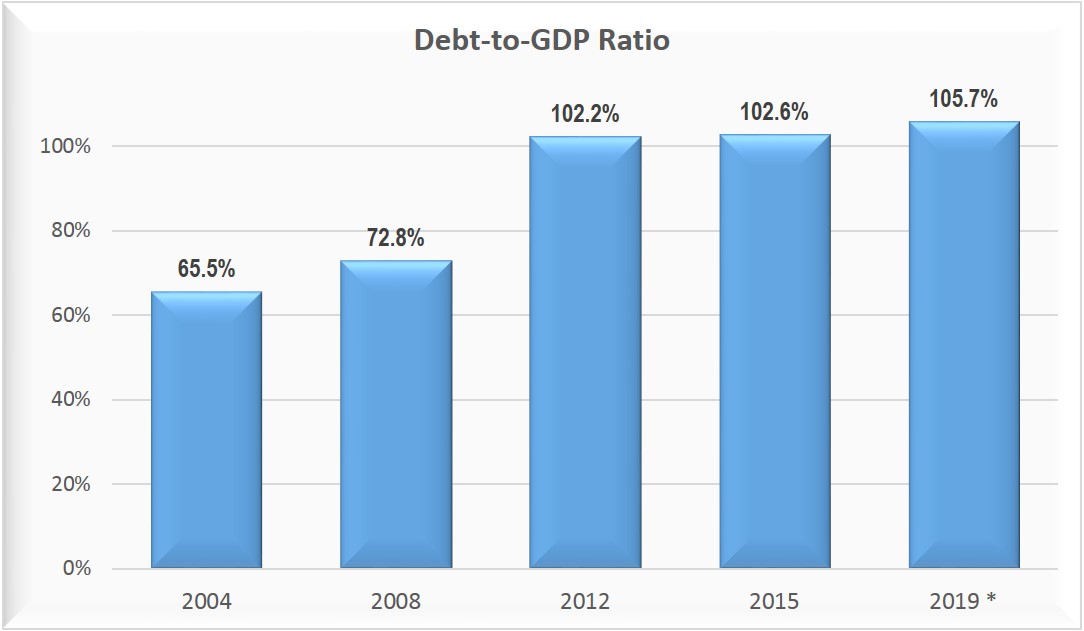
Of course, when a government spends more than it gets in taxes, its public debt rises. At present, the US has a total public debt to GDP ratio of just over 100 percent (A graph by Forbes is here, and a clickable, sortable table is here, but the graphic shows poorly in this page, so you might wish to follow the link.)
Of course, if a country wants to have world class medical and education systems, and first class infrastructure, these things have to be paid for. Talk about America’s ‘crumbling infrastructure’ has become common place, and a report by America’s civil engineers is here. On top of this, the wars in Iran and Iraq were put on the national ‘credit card’ (i.e., funded by budget deficits). Once it became obvious that the wars in Iraq and Iraq were going to take longer than a year, a tax measure should have been put in place to pay for them.
America also has the highest incarceration rate in the world, (about 4 times other advanced countries) and prisons cost money to run. The following quote from the ‘smart asset’ website actually did shock me:
“The American prison system is massive. So massive that it’s estimated turnover of $74 billion eclipses the GDP of 133 nations. What is perhaps most unsettling about this fun fact is that it is the American taxpayer who foots the bill…” [The figure refers to all prison, state and federal –RS]
In October 2013, the US government shut down for two weeks over a fight between the President and the congress over spending, taxes and debt levels. The rest of the world, especially holders of US government bonds got the jitters when it questioned if the American government would be able to pay it bills.
As it is, the US will probably go into the next election with all candidates promising ‘no tax rises, ever.’ This will only mean that the US will continue running budget deficits, although they are getting smaller as the economy recovers from the 2008 recession. A recent Forbes article sums up the current situation, but the last sentence is the most important:
The US budget deficit fell to about $US483 billion in fiscal year 2014, almost a $US200 billion drop from the previous year and the lowest level of President Barack Obama’s six years in office. The US Treasury Department released the official figures on Wednesday, generally confirming figures released by the nonpartisan Congressional Budget Office last week. It’s the smallest deficit recorded since 2008. FY2014 was the fifth consecutive year the deficit declined as a percentage of GDP. It is now an estimated 2.8% of GDP, a percentage that puts it below the average of the past 40 years. The Treasury’s figures chalked up the shrinking deficit to increased revenues from taxes and slowed growth in government spending. “It’s really a rise in revenues because of economic growth, because of the policies the president pursued, that we’ve made progress on the deficit,” said Shaun Donovan, the director of the Office of Management and Budget. The deficit has fallen sharply over the past few years, despite constant brinksmanship in Washington over raising the US debt ceiling. But concern about deficits has virtually disappeared from the campaign trail ahead of the 2014 midterm elections after being a central theme of 2010’s elections. “Politicians campaigning this fall have rarely raised the subject, not to mention the difficult prescriptions that are required to deal with red ink,” said Greg Valliere, the chief political strategist at Potomac Research Group, in a recent note. “No one wants to talk about the deficit.” [Emphasis by RS.]
It’s the last sentence that is the most worrying. If no politician is prepared to even discuss the deficit, no one is going to address the elephant in the room. Americans need to decide if they are willing to pay the taxes needed to live in a modern economy. And with a republican congress opposed to any tax increases, this seems unlikely.
Sometimes voting for politicians who promise ‘no tax increases, ever,” is just a slow and painful way of cutting off your feet, an inch at a time. Sooner or later there’ll be another ‘crisis’ over debt levels, and maybe another shutdown, and the rest of the world will have the jitters when it questions if the American government will be able to pay it bills.
Next week, some figures on Australia’s so-called ‘budget crisis’ that miraculously seems to have gone away in a sleight of hand trick: if it ever existed in the first place.
Kristen Lamb regularly produces some blog post with excellent advice for writers on writing technique, and the use of social media for writers. here’s a re-blog on a recent post of hers.
This blog is re-posted. I know the author, Paul de Lancey, from the Southern California Writers Conference. As for eating the Nigerian spammers who keep sending me messages wanting to hide US$20,000,000 in my bank account, sure!
What is the most annoying aspect of our lives? It is, of course, spam on our computers. Spam is broken down into three basic types: ViagraTM, ways to lengthen your penis, and offers to inherit money from an ex-Nigerian dictator. All of this is only really useful to the kin of Nigerian dictators who are trying to finance penis-enhancement operations. And how many of us fit that description?
How about eat the spammers? Only four problems occur to me. First cannibalism in illegal in all fifty states. (I’m reasonably sure there’s religious exemption for this.) Second, how do we find the spammers? Third. what wine goes with grilled spammer? Merlot? Zinfandel? There are no books for this.
So, cannibalism is out. I never had much stomach for it anyway. I therefore propose a fee on all e-mail. Now hold your horses partner, let me finish. It would only be a…
One only has to turn on the TV these days, or go to any internet news feed, to be confronted by horrific images of religious violence in the Middle East. For those who saw the images of the Charlie Hebdo attacks, and the gunman murdering the wounded policeman on the pavement outside those offices, the religious violence seems all around us. So: Is religion to blame for most of the mass violence in the world?
Karen Armstrong’s Fields of Blood (Random House, 500 pages) traces the history of warfare since the invention of settled agriculture. Armstrong, a former Catholic Nun, has become one of the English-speaking world’s foremost scholars on the history of religion. She points out that in hunter-gather societies, there is no real warfare, except occasional skirmishes with nearby tribes, since the entire population is needed for food collection, and there is no agricultural surplus to sustain a kingly priestly, or soldier class. Once settled farming begins, and farmers are producing enough to support more than their own families, a class of rulers, soldiers and priests can emerge.
The pace of agricultural innovation is terribly slow, however, so the only way that the new ruling class can expand its wealth is to conquer another nearby area and seize its surplus. That’s the start of warfare.
Throughout history, religions have been ideologies that propped up the legitimacy of the ruling class. (Have you ever known of a society where the major religion denied the legitimacy of the ruling class? How did that work out?) Warfare, Armstrong claims, occurs at times of social and economic change, and religion becomes enlisted in the political cause, rather than being the cause.
She also argues that the major conflicts of the 20th century were not religious. The first world war was not religious, and Germany didn’t start world War II to spread either of its two recognized religions (Catholicism, and Lutheranism). In the 1930s, Japan didn’t invade it’s neighbors to spread Shinto and Buddhism: China already had Confucianism and Buddhism, Thailand was already Buddhist, and Korea already had Buddhism.
The most interesting sections of the book deal with the crusades of the Middle Ages, and the religious ward of the 15 and 1600s, where religion really was at the center of the conflicts. The author has a knowledge of history that leaves me for dead. For anybody who wants to get into the history of religion in a serious way, and is prepared to wade through some serious research, this book is a five star piece of work.
For those interested in reading some further reviews before committing to an arduous read, here is one from The Guardian,the New York Times and here is publisher Random House’s description of the book’s subject matter. It’s a meaty read, but it’s worth it.
What would you do if your brain scan showed you were a psychopath? I’ve just finished reading ‘The Psychopath Inside’ by James Fallon (Penguin, 2013, 246 pages.) Fallon was a neuroscientist studying the brain scans of psychopaths: serial killers with no conscience and no empathy. Co-incidentally, he had a folder with brain scans of all his own family members, which he had obtained (with their consent) because, for another study, he needed an entire family in which no one currently had Alzheimer’s disease.
Psychopaths all have certain abnormal features in the very front of the brain: the parts that deal with empathy and conscience. One day looking through his scans, he found one which had the exact features of a psychopath, but was in his family’s folder. Since the scans had numbers rather than names, he asked his research assistant to check who it belonged to, thinking the two sets of scans might have gotten mixed up. They hadn’t. The scan was his.
Fallon had never murdered anyone in his life, and never tortured animals as a child. So what was he doing with a brain scan that showed these types of abnormalities?
The remainder of Fallon’s book is an exploration of why some people become psychopaths and some don’t. Fallon concludes that although he has the physical brain abnormalities of a psychopath, he was stopped from growing in that direction by the loving home environment in his early childhood – something other psychopaths usually didn’t have. Nevertheless, he does show some psychopathic traits. He has exposed other family members to extreme danger, taking his brother camping at night in an area frequented by elephant herds without telling the brother what they were doing. Why? For the thrill of it. If someone offends Fallon, he doesn’t tell them straight away, but will wait for three or four years before springing some revenge on them, at a time they have entirely forgotten about the original incident. And he admits to not going to family funerals or graduations because he just felt there was something more interesting on – such as a chance to go gambling. work colleagues had told him over the years that he was a psycopath in the workpace, but he thought they were joking, or just disgruntled about something he had done, and he had dismissed their claims.
Fallon presents a rare portrait of himself, warts and all. For those who have an interest in psychology, or the nature-vs-nurture debate, this is a very interesting read.
So, what about you? Do you know people who all the advantages in early life and turned into very unpleasant people? Or who had appalling early lives and turned into nice people? Do you think we are any closer to solving the nature vs nuture debate?
Do your Facebook friends ever post things that end with “Only one percent of you will have the guts to re-post this. The other ninety-nine percent won’t”? Or “re-post if you support children with cancer? Those who don’t re-post. I suppose you don’t really care and you are not my real friends.”? Some of my friends do, and I don’t like it.
Sometimes I would re-post, except I resent being TOLD that if I don’t re-post stuff like this with these emotionally manipulative last lines, then I don’t have guts, or don’t care about kids with cancer, or don’t care about soldiers wounded in war, etc. I don’t intend to re-post these manipulative things on principle. The principle is, don’t try to guilt me into parroting your posts. I can decide for myself what I want to re-post. This is snarky emotional bullying.
Here’s a suggestion: NEVER re-post things that are based on guilting you into being a sheep. You have a mind of your own. Your friends shouldn’t need to manipulate you into supporting their social views or their favorite charity. If you feel strongly enough about something to re-post on your own, or you support a certain charity on its own merits, good. If not, why do your friends need to guilt you into being their sheep?
Instead of re-posting their posts, try cutting and pasting the text this blog entry into their Facebook post! I’m NOT suggesting that if you don’t you’re a bad person. That would be against my beliefs. But you could try it – if you feel the way I do.
 The first really important capture of an Al Qaeda member after 9/11 was a man named Abu Zubaydah, the head of logistics for future operations against the US. The CIA feared another attack on the US might be immanent, and they needed to get any information out of him. His interrogators found him an “arrogant,… twisted, smug little creep,” (p.182-183) who told them lots of old news, mixed with outright lies. When using standard legal interrogation methods, and ‘playing by the book,’ Zubaydah’s interrogators were getting nowhere, they sought permission to use a series of nine harsher interrogation steps, from slaps to the face, and escalating measures up to water boarding.
 le of weeks ago, I listened to a man who had spent seven years in jail in Burma (Myanmar) for participating in the student demonstrations for democracy in 1988. Hundreds, or maybe thousands where shot by the army. Nobody really knows the true death toll. During Naing Ko Ko’s time in prison, he was put into the ‘dog cells’, where prisoners were beaten every night around 3 a.m. After being released and leaving the country, he got a scholarship to study in New Zealand, where he currently lives.