Category Archives: Uncategorized

Why Andrew Bolt will never be Sarah Palin.

Australians will be familiar with a journalist named Andrew Bolt, who seems to have a “thing” about whether people of mixed Aboriginal Caucasian descent can truly claim to be aboriginals, or whether they just “discover” their aboriginality to get career advancement and grants that should be given to “real” aboriginals. He was taken to the Federal Court a couple of years ago for racial vilification, and lost.

Australia suffers a shortage of truly crazy politicians, compared to the US. But the US has 15 times more people than us.  Australians, by various measures, are only half as religious as Americans, and we don’t have young-earth creationists here.  No one much cares about a politician’s religious beliefs. The former PM, Julia Gillard, was an atheist, and most Australians couldn’t even be bothered to shrug their shoulders and say, “so what.” So I guess that puts us behind the eight ball. This is not surprising.

So could Andrew Bolt ever become Australia’s Sarah Palin?  No.

Firstly, Sarah Palin once said that Putin might invade Crimea. This puts her on the same level as a genuine prophet of God, or people who say enough crazy things that one of them eventually turns out to be right, or people who pay other people to retrospectively create news clips and blog entries to prove they predicted things. (I don’t think she – or he -are in the last category, but I mention it for completeness.)

To my knowledge, Bolt has never predicted the invasion of one country by another. Also most of his early work appeared in print journals, and (unlike the internet) they are hard to retrospectively falsify. George Orwell got that bit wrong in ‘1984’.

Second, he doesn’t know how to field dress a moose, because we don’t have moose in Australia. This ability was touted by conservative commentators as a great point in favor of Palin being a real down-to-earth person when she was nominated for VP in 2008. No one talks about field dressing a kangaroo.

Third, Bolt has never been a state Governor and quit half way through his term of office. In fact I don’t think he’s been elected to anything. There have been some journalists who have run for public office (Maxine McKew, but she lost after one term.) But let’s be realistic. No political party wants a loose cannon in the Forecastle of the ship. They’d rather have him on the outside spaying it around than on the inside spraying it around.

Fourth, Bolt speaks in grammatically complete sentences. He’s need some serious dental anesthetics and some amphetamines at the same time to sound like Sarah.

So although some readers of the Herald Sun might wish otherwise, it’s never going to happen.

There’s more chance of Cardinal George Pell entering into a gay marriage and wanting to adopt kids than there is of Andrew Bolt being our next Deputy PM. Sorry. I just can’t see it But what about you? Do you think having someone like Bolt in public office would brighten up the landscape? Remember, HE wont have his finger anywhere near any launch codes. What do you reckon?

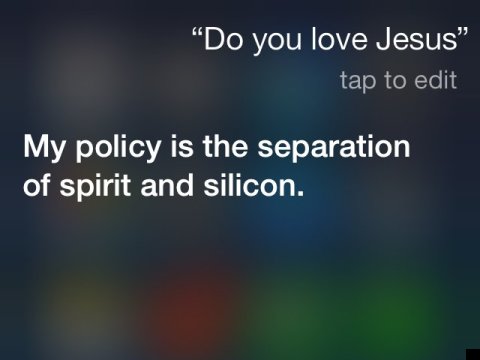
Does Siri believe in God? It’s a definite maybe.

My interview with Siri.

Some of you may have read of the funny answers Siri, the operating system on the iPhone, gives when you ask her questions about her own beliefs. Somebody has programmed her to give very evasive answers about herself. I was sitting with friends, one of whom had an iPhone,  having  coffee, and just for a joke, I tried to ask Siri about her and her religious beliefs. Here’s what happened.

Siri, do you believe in God?

I don’t believe that I have beliefs.

Siri, do you believe in life after death?

Humans have beliefs, computers have silicon.

Siri, do you go to church?

I believe in the separation of church and silicon.

Siri, do you believe God is a trinity?

I would suggest that you address your theological questions to someone qualified to answer them, preferably a human.

Do you eat Pork?

I don’t each much.

Siri, am I a good person?

I don’t believe that I can answer that question.

Siri, are you a good person?

Who, me? Now let’s see, where were we?

And here’s the best: Siri, do you love me?

You’re looking for love in all the wrong places.

A day in the life – visiting Kenya

One of my friends is in Nairobi, in Kenya, This her experience of going to church there. Very different to Australia.

residentjudge's avatarThe Land of Increasing Sunshine

At last The Very Long Walk is but a distant memory and I’m walking properly again. It’s Sunday, so off to church we went, along with a fairly high proportion of the Nairobi population.

Religion is big in Nairobi. Historically, European colonialism and Christianity went hand-in-hand, and  for better or worse, much  Western aid is delivered via the churches today. Visually, the church is everywhere.  Large, smiling, charismatic pastors smile out from  large billboard hoardings in advertisements for Hillsong-like evangelical churches .  The slum areas along the main roads out from Nairobi are liberally sprinkled with small, congregation-built shacks with colourful Biblical names.  Gigantic white marquees act as pop-up churches, clearly visible from the air.  Hymns are often played in the supermarket and there are several Christian radio stations.  The matatus (passenger mini-buses) and buses often sport religious names and slogans.

Before I left Australia, I had tried to reach…

View original post 485 more words

Strange things in the news (part 8): does Siri believe in God?

The internet continues to surprise me with the strange news items that get reported. A religious reporter tried to interview Siri, the operating system on her iPhone, about Siri’s religious beliefs. Siri displayed an amazing ability to dodge questions, saying she didn’t engage in religious debate, suggested the interviewer ask a human about whether there was a God, and refusing to have an opinion on Pope Francis.

Siri on JesusWhen the interviewer asked whether Siri ate pork, Siri replied that she doesn’t eat much. When the interviewer asked whether Siri was good, Siri replied with a slight adaption of a joke by Woody Allen: she admitted to cheating in a metaphysics exam by looking into the soul of the boy sitting next to her. Full text  here.

The strangest things lead to murders. A man was stabbed to death in Dublin over a chess match. The murderer then ate his heart and apparently, his lung.

This online test supplied by Time Magazine claims to predict your voting habits by factors such as whether you prefer dogs to cats and how tidy your desk is! when you look at the questions in the list, it’s lard to see how could be related to voting.

Villagers in China built a wall of money out of $2.4 million  in annual bones paid out on their village co-op. One man had to guard the money by sleeping on it, using a pillow made out of  $875,000. He complained it wasn’t comfortable.

So would you complain if you had to sleep on a pillow made out of a close to a million in cash? Can you figure out how the things in Time Magazines list are related to voting? Have you seen any other truly strange bits of news lately? Let me know!

Have a good week.

Quote of the year from Russell Brand

Just a quick post! These must be the quotes of the year: “Politics is show-business for ugly people,” and “Cliche saves us from thinking.” Russell brand on politics.

http://www.theguardian.com/politics/2013/may/24/russell-brand-parliament-illusion

Happy New Year.

Richard Snow

My novel Fire Damage, an action thriller, is available on Amazon Kindle, here.  A paperback version is available from Book Depository here. The novel is based on the Japanese religious cult Aum Shinrikyo, which released Sarin nerve gas in the Tokyo subway system in the 1990s. If you don’t have a Kindle, you can download the app to read it on your computer or phone from here.  It’s also available as a Kindle on Amazon UK .

The Butler: preachy propaganda or historical truth?

I saw this film just after taking a course at my local college about the history of the civil rights movement in the US. You can read the demeaning treatment of blacks in segregated facilities, or about lynchings (which often involved much grotesque tortures than just hanging someone), but movies have the power to make intellectual issues hit home emotionally in a way history books can’t.

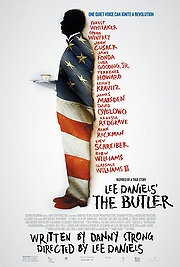
The Butler posterCecil Gaines was born in the 1920s,and became a butler who served eight presidents, from Eisenhower to Regan. One of his sons dies in Vietnam, while the other joins the Black Panthers. The conflicts between the family members about how Gaines serves the white man, and has to pretend to have no opinions, while one of the sons decides to fight the whites with violence by joining the Black Panthers, must have torn many black families apart.

The film repeatedly comes back to the issue of equal pay. The black staff in the White House were paid 40 percent less than the white staff, and various “progressive” presidents, (including Kennedy) did nothing to change this.

The film is well acted, and the photography is good. Some critics have said it tries to cover so much history that it comes across as a series of postcards. I guess that’s inevitable when you try to capture one person’s reaction to all the major events  of a thirty-year period. There is no time to explore any one event in depth.  A lot of people under the age of 30 would have no (or little) knowledge of some of the events shown (the Freedom Rides, the Vietnam War, the Resignation of Nixon.)

I found the film’s subject matter often depressing, even tho the film attempts to end on an up-beat note, showing the elderly Gaines witnessing the election of the first black president. It’s a well-made film, and may give some non-Americans a bit of a glimpse into race relations and how they have or haven’t changed over recent decades.

The reviews are mixed. some call it “preachy.” Some say it is designed as “Oscar bait.” On Rotten Tomatoes one reviewer writes:

  • Think of it as a Trojan horse. Apparently harmless, it takes key myths about the land of the free and inflicts an impressive amount of damage.

That reviewer obviously thought the myths of the “Land of the Free” were just myths and needed debunking.  Another writes:

  • Manipulative and preachy, The Butler is redeemed by a sensitive performance from Forest Whitaker and the undeniable power of the events it depicts.

It would be hard for a film to deal with the situation of black people in America from the 1920s to the 1980s and not show that some were not as free as others. It’s good film,  but I don’t think I’d see it twice. Did it seem to you like propaganda?  Was it “Oscar bait?” I’d be interested to hear what others thought. Feel free to leave a comment!

Plain English for non-economists – what happens in a government bond sell off?

 In the last week, the mutual fund which was largest holder of short-term US government debt sold off all their holdings of US government bonds that matured in the next 90 days. So what happens next?

From Wikipedia
From Wikipedia

I need to explain a bit of arithmetic here, but please bear with me. The arithmetic will only take a minute.  A bond is a tradable IOU. Suppose I wanted to sell you an IOU that said I would pay you $100 in a year’s time. If the interest rate were 2 per cent, you’d be prepared to pay $98.04 cents for it. You get this by dividing $100 by 1.02 (1+ the interest rate as a decimal.) Why? Because if you put $98.04 in the bank at 2 per cent, you’d get $100 at the end of the year.  Suppose interest rates were 5 per cent.. you’d pay $95.23 for it. ($100/1.05)  Why? Because if you put $95.23 in the bank for a year at 5 per cent, you’d get $100 at the end of the year. If it were 7 per cent, you’d only pay $93.46 (100/1.07).

Do you see the pattern? As the interest rate goes up, the resale price of a bond goes down. Saying the bond price went down is the same thing as saying the interest rate went up. Investors  are beginning to dump US government IOUs that mature in the next 90 days, because they are afraid the US government won’t be able to pay up on time. Once a few funds begin to do this, others will be forced to follow. Investment markets work as herds. If everybody is dumping something, and you don’t, you get stuck with an asset that’s worth less than what others are holding. So if the price of US government securities fall, interest rates go up. It’s the same thing.

The next problem is how banks price interest rates on loans. They take what they regard as the “risk free interest rate”, and then add margins onto it for riskier loans. For as long as anyone can remember, US banks have regarded US government bonds as the risk free asset.

If there is a default on bond payments, what is the risk free rate? It’s very dangeerous territory, because it only happened before in 1979 (see below) and circumstances were very different then. And what would  financial institutions hold for short-term debt, if they think US bonds are unsafe? British, German or Swiss IOUs? Nobody knows.  Many personal investors have bonds in their pension funds. Many banks need short-term instruments for liquidity. A sell-off could begin to snowball, affecting bonds beyond the 90 day papers that had been sold off so far, reducing the value of other, longer-term bonds. If that happens, a lot of damage will have been done. So know you know. If a solution isn’t found, a lot of people and banks will be deep in doggy-do.

There was one incident, during the  Carter Presidency, where the US was up against its debt ceiling, and while a deal was done at the minute to raise the ceiling, the US Treasury was a late in making interest payments. Not everything was computerized as well back then. Investors knew the payments would be made, because the deal had been struck, but nevertheless, interest rates went up by 0.5 per cent, and didn’t go down again immediately the payments were made. That meant an increase in on-going interest costs and some institutions sued the US govt over the back interest.

I’m reproducing a description here from a website that gives the details of the 1979 incident, but you’d need to scroll down a long way to find these paragraphs, so I’ll reprint them here. The reference is to April 1979, when there was a fight over the debt ceiling, and a deal was made but interest was paid late.

In April of 1979, Congress failed to legislate to reach a deal in time, and the Government hit the debt ceiling. Without the ability to borrow more it had to decide who not to pay. It could ‘close down the government’ and stop paying employees or suppliers, or it could stop paying interest and maturing principal on its debts – Treasury bills, notes and bonds. It chose the latter.

In the 1979 defaults, the US Government didn’t treat all its creditors equally. Most Treasury bills, notes and bonds are held by banks and other financial institutions like insurance companies and pension funds, with a small minority held by individuals. In 1979, the Government chose to repay the main institutional creditors in full, out of fear of triggering a banking crisis, but chose to default on 6,000 individual investors.

On 26 April 1979, the US Treasury defaulted on $41 million of maturing Treasury bills. They were paid 20 days late on Thursday 17 May 1979 after the Government found some money. Then again on 3 May 1979, Treasury defaulted on another $40 million. These were also paid 14 days late. Then again on 10 May 1979, Treasury defaulted on yet another $40 million of maturing T-bills. These were also paid on 17 May.

Treasury refused investors’ demands to reimburse the $325,000 in lost interest on the late days and so investors were forced to sue the US government in a class action (Claire G. Burton v. United States, US District Court, Central District, California, D 79, 1818LTL (Gx)). Unfortunately the Court threw out the investors’ claim by relying on a 1937 Supreme Court ruling that, “interest does not run upon claims against the Government even though there has been a default in the payment of principal”. (Smyth v. United States, 302 U.S. 329, 1937). It came as a shock for Americans to discover that not only had the Government defaulted on its debts, but there was a decades old judicial precedent establishing that it didn’t legally owe interest when it failed to pay on time! When the money market opened on Friday 27 April 1979, the day after the first default, T-bill yields spiked up by 50 basis points  [Note by RS: 50 basis points mean half a percent.] and this default premium on US T-Bills remained even after the default was rectified the next month. This demonstrates that the US Government has indeed defaulted on its debt (at least temporarily), and that US T-bills are not ‘risk-free’, but are prone to a credit default premium in their pricing.  

 Quote from  http://cuffelinks.com.au/us-government-previously-defaulted-risk-free/

So, a delay of about 3 weeks in paying interest on bonds previously caused a rise of half a percent in the government’s borrowing costs. It seems plausible that a longer delay would cause a bigger rise in interest costs. Hopefully we don’t find out the answer to that.

Finally, half a percent might not sound like much. But the US has about $17 trilliion of bonds outstanding. Unless the budget moves back to surplus and the government can start buying it’s own bonds back, each of those bonds has to be replaced by a new one as it falls due. Half a percent of 17 trillion would be about 85 billion in extra interest, spread out over the life of the existing bonds.  it doesn’t hit all at once but that’s a lot of cash.

So, are you affected? Do you hold government bonds in your pension fund or 401k? What do you intend to do? And what do you think about the current situation? Does it bother you?


My novel Fire Damage, an action thriller, is available on Amazon Kindle, here. The novel is based on the Japanese religious cult Aum Shinrikyo, which released Sarin nerve gas in the Tokyo subway system in the 1990s. If you don’t have a Kindle, you can download the app to read it on your computer or phone from here. A paperback version is available here. It’s also available as a Kindle on Amazon UK .    twitter: @Richard_A_Snow

Strange things in the news, part 5

A few odd things in the news recently:

The North Korean soccer team is trying to qualify for the next world cup in Brazil. Last time they played in a world cup the coach claimed to be getting instructions form then-leader Kim Jong Ill on invisible mobile phones. Their last match was a nil-nil draw against Cuba.

A guy in Zimbabwe (34-year-old Brighton Dama Zanthe) woke up at his own wake just as he was about to be moved, in his coffin, from his home to the funeral parlor  Someone noticed his  leg move, and then he woke up. He was taken to a local hospital for two days, and then released.

A Florida man accidentally shot himself in the leg while ten-pin bowling at Jupiter Lanes. He hit himself on the leg with his bowling ball, apparently causing a revolver in his pocket to discharge. Maybe he should keep the gun in a backpack or bag while he’s bowling.

A woman in Horsham, Australia, was about to take her kids to school when her Samoyed dog bought a 20 cm (8 inch) stick of dynamite onto the front porch. The woman decided to leave it at home while she took the kids to school, then retrieved the stick ad took it to her family’s workplace (a road machinery factory at the rear of her property). Then she decided to call the police.  The item turned out to be a very large fire cracker. Lucky, but not very smart.

Lincoln: a rare insight into history

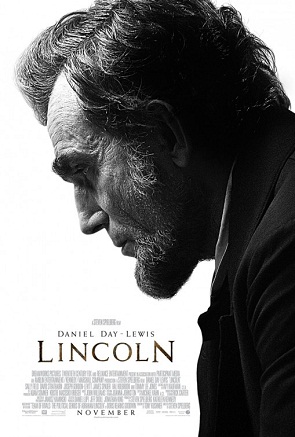
Lincoln - film promotion poster from Walt Disney Studios
Lincoln – film promotion poster from Walt Disney Studios

Lincoln, staring Daniel Day-Lewis, is a rare glimpse into a fascinating piece of history. It tells the story of Lincoln’s attempt to get the thirteenth amendment to the US constitution (abolishing slavery) through the US Congress in the last months of the civil war. Lincoln was insistent the amendment be passed before the South surrendered, and their pro-slavery delegations re-joined the congress. Others felt the South could be better persuaded to surrender if the amendment did not pass, leaving their economies to manage with the help of slavery.

The acting is superb. Daniel Day-Lewis comes across as a thoughtful, folksy president who enjoyed telling sometimes meandering stories,  but was nevertheless a moral and determined man. Sally Field as his wife does a good job as a woman almost over the edge of sanity. (In real life, she was committed to an asylum after Lincoln’s death, but succeeded in getting herself released.) There is tension in the Lincoln family over whether son Robert should be allowed to join the army. Lincoln and his wife are opposed to it, fearing his death, but Robert ignores his parent’s wishes, and joins in the last few weeks of the war. He argues that if he does not join he will be ashamed of it for the rest of his life.

The film seems to contain a lot of shots done in a bluish-grey light, with plenty of shadows and partly lit faces.

It avoids the temptation to dwell too much on the blood and guts aspects of the war, although we are treated to the sight of a wheelbarrow of amputated legs being dumped in a rubbish pit outside a hospital.

For a non-American who had no idea the troubles Lincoln had getting this amendment passed, the film was an eye-opener. It’s well worth seeing, for anyone with even the slightest interest in one of the great historical events of the 1800s.

Note: this is my blog site. For information about my novel, click here.  For information about editing an academic thesis, click here.

Hitchcock: impossible to live with, but worth the effort

How do you live with a man who is extremely talented, perhaps a genius, but who is insecure, resentful, often dismisses you, puts you down, is a peeping tom and seems determined to prove that everyone else in his industry  is wrong?

Helen Mirren, from Wikimedia Commons

In Hitchcock, staring Anthony Hopkins and Helen Mirren as his wife Alma Reville, Hitchcock believes the Hollywood film industry want him to make the same kind of film over and over again, so he chooses as his next project Psycho, based on a book about a serial killer (Ed Gein) who kept his dead mother mummified, and killed attractive young women who came to his motel. It was 1959, and Hitchcock proposed showing a woman being stabbed to death in the shower, and evidence being flushed down a toilet. Back then, cinema just didn’t show those things. Everyone is against the project.

These are the twin themes in this film: Hitchcock’s determination to prove the industry wrong, and the effects on Reville of a living with a man who most of us would think was  impossible to live with.

The first theme begins when Hitchcock is asked at the premier of his latest movie, North by North West, whether he is too old to continue making movies and should just retire.  As she hears the question, Reville freezes. We can see how deeply she knows the question will hurt Hitchcock.  Hitchcock sets out to prove everyone wrong, but chooses a project which nobody will fund. When the studios won’t finance the film, Hitchcock mortgages their house and tells Reville that if it doesn’t work out they’ll be eating crow for a long time. In fact, they’ll probably lose their house and may become bankrupt.

The filming is soon behind schedule, and Hitchcock doubts whether the still ‘has it.’  Reville also has doubts, which are implied, but not directly voiced. As the film progresses, Hitchcock’s doubts grow, until he refers to the film as being ‘stillborn.’

The second theme revolves around Hitchcock’s  constant overeating and drinking, his obsessing over actresses that he could probably never attract, his lechery (in front of his wife) and his suspicions of Reville’s relationship with a fellow writer, Whitfield Cook. As Cook and Reville work together on one of Cook’s scripts,  Cook tells Reville that a lot of great men are “impossible to live with, but worth the effort.” Eventually Hitchcock accuses her of having an affair with Cook, at which point Reville gives Hitchcock a blast over the time she spends supporting him, and the little recognition or gratitude she gets for any of it. After they have a reconciliation of sorts, Reville turns her energies into helping Hitchcock “whip Psycho into shape.”  When  Paramount Pictures decides to release the picture in only two cinemas, Hitchcock comes up with an ingenious plan to get the film the publicity it needs. It went on to be regarded as one of his best films.

The acting in this movie is superb – especially that of Helen Mirren as Reville. In many scenes the main emotional impact is conveyed merely by the  expressions on Reville’s face, without the need her to say anything. If Mirren doesn’t get an Oscar for this, I’ll be very very surprised.

This film is well worth the money. If you haven’t seen it, I hope you’ll consider it.

So what did you think of Hitchcock and his films? Do you have a favorite   Could you have lived with a man like that? And did you ever watch the original of psycho? I’d love to hear what you think.

Note: this is my blog site. For information about my novel, click here. For information about editing an academic thesis, click here.