Jesus on Mars: what I’m reading this week.

Jesus on Mars, by Philip Jose Farmer, has an astonishing plot premise. What if humans landed on Mars, and, in a hollowed-out mountain, found a human community who followed orthodox Jewish teaching? The humans were picked by up a space ship in AD 50, which rescued them from some dangerous situation. (We don’t get to learn much about the situation.).  The space ship in which they landed on Mars is just near the hollowed-out mountain. Along with the Jews, they picked up the resurrected Jesus.

Although this book was written in 1979 there is nothing that “jars the reader” because Farmer tried to predict the future and got it wrong.  The four earth crew who land on Mars include one Baptist, a Muslim, a lapsed Jew, and a woman who has been an atheist for many years.

They undergo a lot of internal conflict as they try to come to terms with Jesus’ apparent miraculous powers: making things levitate, having the head cut off a ram and then restoring the head to the animal, after which it walks off quite happily.

The Jesus announces that he will be coming to earth in the space ship that has been lying outside the mountain . This is broadcast directly to earth TV stations. That’s when the fun starts, but I won’t give away any more of the plot.

Science fiction is sometimes divided into ‘hard’ and ‘soft’. Hard scifi gets all the technical and scientific details right, in great detail. ‘Soft’ scifi is mostly about the characters and their relationships, like ‘soapies’,  Star Trek Voyager’ and ‘Star Trek the Next Generation’ were soft scifi. I’d recommend this book to anyone who likes “soft” science fiction. Some copies are available on Amazon.

Passing as another race – what I’m reading this week

Passing as another race: what I’m reading this week.

The book-reading group I belong to is going to be talking about Philip Roth’s “The Human Stain” next month. This deals with a topic I’ve only seen mentioned in one other book: people of African American decent “passing” as white. I’ve been vaguely aware that this exists in America, but it’s never been something I’ve had any reason to think about or discuss with any of my American friends. So, first a summary and then a few questions.

Roth’s book revolves around Coleman Silk, a college professor who is incorrectly accused of racism because one day, as he’s marking the attendance roll, he refers to two students who have never shown up for class by saying “Does anyone know these people? Do they exist or are they spooks?” I’ve never heard the word used in this sense, but apparently “spooks” is one term for African Americans. I’ve always thought a spook was either a ghost or a spy. In fact the two students are black, and lodge a complaint against Silk, which ends with him leaving his college. In fact Silk is actually a green-eyed, white-skinned African American who enrolled in the Navy in WWII passing as white. When he left the navy he got a scholarship to university as a white. For 50 years he has pretended to be white, in fact, to be Jewish. It is not until after Silks death that the narrator of the book meets Silk’s sister, at his funeral, and she tells the narrator of Silk’s history. Silk has just been buried as a Jew. He has, intentionally, married a woman with crinkly hair in case any of his children were born with crinkly hair. Silk’s only communication with his family has only been telephone calls between him and the sister, since he could never allow the two worlds to meet.

When he decided, 50 years ago what he was going to do, he told his mother and she said she realised his (future) children would never know her as their grandmother.

The book is set in 1989, during the time of the Monika Lewinsky scandal, i.e., it’s fairly recent in historical terms.

In Australia, the opposite issue to “passing” has arisen recently in a court case involving journalist Andrew Bolt, who suggested in a newspaper article that some fair skinned people of mixed descent identify as aboriginal in order to get art prizes and jobs reserved for aboriginals. But these people acknowledge their Austrian or English ancestry is not a secret – they couldn’t really hide it even if they wanted to) so the issue is not quite the same as in Roth’s book. (There’s a Wikipedia article on Bolt with links to his articles.)

It set me wondering: do light skinned African Americans today feel a need / or see a benefit from “passing” as white? How often on forms do people have to state their race? (I can’t recall any internet forms asking me my race (even just for ‘statistical purposes). Is it regarded as treachery to one’s group? Anybody got any thoughts? Anybody want to enlighten me?

Kristen Lamb’s Blog contains good articles.

Today I’m not going to say anything about economics or politics. Promise. Kristen Lamb’s blog (http://warriorwriters.wordpress.com) has an excellent article headed “Taking Your Novel From Good to Great” which contains a guest blog by Danielle Poiesz about the website “bookcountry.com”.  Book country is a site where authors can upload books (or drafts) and get comments and feedback from other writers or readers. There are sections related to specific genres, articles about the business  side of writing, and articles  of advice by authors. One, by Jamie Freveletti, has “Ten Tips I Received… and sometimes Ignored.” It opens with the quote “Persistence is the only thing that has the ability to move you closer to being published. The first tip is “write every day.” She doesn’t, she admits: how could you raise kids, work as a lawyer, and write every day? But she says even under those conditions she managed to write every other day. Boy! That’s a mighty feat. It reminds me of a quote attributed to American President Calvin Coolidge about persistence and determination alone  being omnipotent. One of the reassuring things in Freveletti’s article is that her first book didn’t get published, and that’s not uncommon. Well, I guess this entry ended up being more about book country than Kristen Lamb. But check out Kristen Lamb’s site. Apart from her own articles, she has lots of useful links to other sites and blogs. Best wishes.

Politics, Money and Personal Abuse.

My last post on “Why aren’t more Americans more visibly angry?” drew a few responses.
Tameri says “I am totally pissed at where our country is right now … (but I) desperately want to believe that (politicians) genuinely have our best interests in mind when making decisions.” She concludes with “I’m pissed, but feel impotent to change anything. What would you suggest we do?”
Rissa points out that no one forced people to take out mortgages they couldn’t afford and then draw down equity to buy “a boat or some other expensive plaything… Where is the outrage at their part in crashing the economy?”
Valerie (garagesalefinder) posted a fairly punchy reply. She says “I believe quite the opposite of Tameri about our elected officials. I don’t believe most of the politicians have our best interests at heart. I believe they have their own self-interest in mind with the decisions they make.” She is upset at the influence of lobbyists and says about politicians, “for the most part, if you have enough money behind you, you can spend your way into office. That tends to make them susceptible to influence by rich lobbyists.” She adds, “I find it fascinating that nobody is protesting in Hollywood outside the studios where top actors make tens of millions of dollars for a few months of work. Or protesting outside stadiums where athletes are paid millions of dollars for playing games.”

Cheryl says, “Since the protesters [the occupy Wall Street groups] are standing up against the very corporations who have bought and paid for both sides of the government, through lobbying and political donations, they’re not likely to find much sympathy with the politically motivated media.” And she wants lobbyists and corporate funding of politicians outlawed.

Andrew asks why he should care about the distribution of wealth. “If you redistribute that wealth, what do we get?” (The figure of 1.5 trillion – Forbes estimate of the wealth of the top 400 in the US – were spread over 150 million people would be $10,000 per person. Not that such a redistribution is politically possible, even if a society could actually reach agreement on such a thing.

Where should a discussion like this go?

Let’s look at two problems my writers have identified.

It seems odd that Americans who are left-leaning believe the media are controlled by large companies (and hey, they don’t get any bigger than News Corporation) while those who are right-leaning believe that the ‘liberal media’ distort the news leftward. On the face of it it’s hard to imagine the media as a whole being left leaning. After all, if newspapers and television stations aren’t owned by large corporations, who are they owned by?

I lament the fact that what should be intelligent coverage and debate over national issues is trivialised and turned into entertainment, where professionally indignant shock jocks simply make provocative statements and then insult and talk over the top of listeners or viewers who disagree with them . The level of debate in politics in Australia is lamentable. Ten second sloganistic sound bites rule the media. And I don’t see much higher level of debate in Britain or the US. Sorry to anyone who feels offended at that.

If there is to be intelligent debate about issues, I suspect it has to take place on the internet, free from the domination of corporations that own the TV stations and newspapers. BUT, on the internet too much discussion about political issues just turns into personal abuse, with posters on many forums giving no sources for their alleged facts. Too many posts in blogs and websites turn into ‘you’re a socialist liberal communist / right wing repiglican asshole’ (or insert whatever insult the writer feels happy with.)

Somehow, some of us have to make a conscious effort to engage in debate without descending into personal abuse, and start to cite sources for our facts, and concede that there might be possible arguments against our own positions.
We need to recapture the notion that political debate is something more than name calling.

Perhaps the replies that resonate the most with me are Valerie’s and Cherly’s comments on lobbyists and money in politics. It seems that to make it thru a primary election season in the US a politician has to be independently wealthy, or get a lot of donations from large corporations. Five of Obama’s top 20 campaign donors in 2008 were Wall Street banks. (I didn’t know this until last month, but the information is easy to find once you google it. Look for the “opensecrets.org” website and the Centre for Responsive Politics” ) Somehow, those of us in democratic countries need to be pushing for laws that aren’t in the interests of the people who would need to enact them. That’s a tough ask.

But somehow a groundswell of public opinion needs to be created that says ‘NO, it is NOT OK for Goldman Sachs to donate $1 million to a political candidate.”

Any thoughts on how this can be done?

Why aren’t more Americans more visibly angry?

The thing I can’t work out today is “Why aren’t more Americans more visibly angry?”

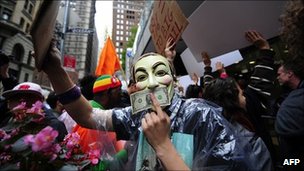
I have just watched the BBC, CNN’s, MSNBC’s and the Guardian’s coverage of the “Occupy Wall Street” movement. Yes it’s spreading to other cities, but look at the numbers involved: 4,000 in New York, and figures ranging from a few hundred to a couple of thousand elsewhere.

Why am I perplexed?

Photo from BBC
Photo from BBC

In the early years of the war on Iraq, after the world knew that the justification for the war had been sexed-up and fabricated, I waited for the protest to begin. The death toll in Afghanistan and Iraq grew steadily. But  no 1960s –style antiwar movement seemed to develop.  I read a book by  one deserter
who fled to Canada, as many did in the 60s to dodge the Vietnam draft. There
may have been others. But I didn’t hear of any mass movement.  I figured that when the death toll in Iraq passed the toll of 9/11 something would trigger a mass revolt against the war. But no. The silence was deafening.

It’s now 4 years since the Wall Street banks’ behaviour pushed the American economy into a crisis from which it is still hurting badly. Houses have been foreclosed on, unemployment is 9 per cent, and Zuccotti Park has what?  4,000 people in it. Commentators on the internet are assuring their audience that the Tea Party people were angry at bailouts when they first began. But I don’t hear their anger at the claim that the richest 400 people in the US have as much wealth as the bottom 150 million.

I’ve had the good luck to live in a country that’s still growing economically, thanks to the  fact that China and India, to which we export, are still growing. And by sheer dumb luck, Australian banks didn’t get involved in the American sub-prime derivates and mortgage bundles.

So why do I care?

I’ve often been fascinated by American politics.

The first political saga I ever took an interest in was Watergate. As an 18-19 year old in Australia in 1973-74, I watched in morbid fascination as  the efforts of a President to cover up illegal conduct by his staff brought him undone. My education on abuse of power here in Australia had to wait for the stacking of the Senate against Prime Minister Gough Whitlam in 1974-75.

More of America’s political processes take place in public. They have the primary elections process starting in New Hampshire in February, but effectively already underway 6 months early. You can watch the jockeying taking place in public. Right now, you can watch republicans consider electing a man who believes in magic underwear to the office of President. (And if you don’t know what that means, Google ‘Mormon garmies.’)  In Australia, when Julia Gillard knifed Prime Minister Kevin and the party dumped him as leader, the deal was done in back rooms and became public after it was an established fact.

The US is still 20 per cent or so of the world’s economy. It is the only country that can afford eleven aircraft carrier strike groups.

Abraham Lincoln Battlegroup – picture  from Wikipedia

The US still produces a lot of
the ideas and popular culture that influences the rest of the world. And you
can’t escape that America has 312 million people in it, compared to 22.7 back
here. The means the bell curve is 14 times bigger and the tails  of the curve are 14 times thicker, and extend left and right further than here. So when it comes to extreme opinions, well, 22 times as many people means… you guessed it. And as Regan and Thatcher showed, and later Bush and Blair, if an American President can get even one other world leader onside, they can do things that effect millions of people in other countries.  I still regard America as a source of noble aspirations and ideals, even if it’s health-care system and it’s limited unemployment insurance causes one of my female friends to say the thing she dreads most over there is the idea of getting seriously ill. I like the separation of powers that the framers of its constitution came up with.

I’ve been to the US eight times, tacking on trips to Canada, Mexico, Peru, Brazil and Argentina as I went. I’ve been to California, Arizona, Las Vegas, the Grand
Canyon, New Orleans, New York, Washington DC, Philadelphia, and Boston.  I have friends there, some of whose political opinions strike a chord with me. With others, I have learned to shut up. Of my facebook friends in the States, only one is persistently angry in her facebook posts.

So coming back to my first question: why aren’t  more Americans more visibly angry? Is it a sense of futility? Do they believe that they could protest all they like, but it wouldn’t make any difference? Are they too focussed on keeping the job they have, and not making waves? Or is it the belief that they’ll get thru, one way or another. That somehow they will survive. Or that complaining is unseemly when so many others are in the same boat?

Meanwhile, Manhattan has 1.6 million people, and only 4,000 are in Zuccotti Park.

Any readers out there want to make a suggestion?
The friendliness of strangers.

I was at university today, sitting on one of the benches outside the library, just in front of the window of a café that’s in the library. I had a notepad out and was working on a stats problem.
A young guy and girl approached me and said “Excuse me sir, can we get you  coffee?” (Who calls strangers “sir” in Australia? America, yes. But here?)  I thought they must be… from the café trying to drum up business, so I asked.  “No, we just noticed you working here and we wanted to buy you a coffee.”  I was a bit perplexed. I wondered if I looked like I couldn’t afford a coffee. (I was wearing a pair of jeans that are a bit faded and had ink stains where a biro leaked in the right side pocket. Maybe I’m dressing too down-at-heel.)
There had been a TV show here in Australia recently that said the way to happiness included practicing random acts of kindness. I asked, “Are you doing random acts of kindness?” “We just want to buy you a coffee. What do you have?” I figured “What the hell – why not?” and said, “A latte.” They disappear. I wonder if once they get the coffee they’ll want to start talking about Jesus and I’ll be captive because I’ve accepted the coffee. They come back with a latte. Then we start talking. He looked vaguely familiar. It turns out she’s in the same calculus lectures as me, and he sits in just to be with her. She’s Ermina and he’s Tom. We start talking. They don’t want to talk about Jesus.
She tells me she’s born in Bosnia and her family fled to Germany when Yugoslavia disintegrated. We talk about her family’s life there and here. Her dad’s doing an economics degree at the same uni. Her family were Muslim, but she doesn’t wear the garb.
She tells me how after she was born,  her mother tried to register her birth. The fighting had just started. For seven days, the officials at the registry office wouldn’t register her birth because they couldn’t agree on what to put on the heading of the certificate. Yugoslavia? The Republic of Bosnia? Or is it Bosnia and Herzegovina? But without a birth certificate the mother can’t get the daughter added to her passport, and they can’t get the child out to Germany.
Finally someone makes a decision on what the letterhead should read. Her birth certificate is now stored somewhere safe. If she loses it she may not get another. They’re just two likable twenty-somethings who were happy to have a conversation with a fifty-something. The world feels nicer today. After the next lecture, I must buy them a coffee.

Speaking up for women in Afghanistan. A remarkable story.

I’ve been reading “Raising My Voice” by Malalai Joya, an Afghanistan woman who was expelled from the Afghan parliament in 2007 for criticizing the presence of warlords. When she was only a few months old, her family had to flee to Iran while her father fought the soviet occupation which began in 1978. She grew up in refugee camps in Iran and Pakistan. Iran did not let girls in the camps go to school, and her family eventually moved to Pakistan to a town that had a girl’s
school. She intersperses her own story with bits of recent Afghan history: how the CIA funneled money into mujaheddin groups chosen on the advice of Pakistan’s intelligence services. When the soviets were defeated many of the groups began fighting each other for power.

In ninth grade she became a school teacher, which gives us some idea of the level of education of many of the other women she was teaching; in a word, ZIP.

At sixteen, having completed year 12, she returned to Afghanistan. The Taliban were in power. Girls were not allowed to go to school (again!) and she began a girls’ school in a basement of sympathetic householder, teaching women the unthinkable: how to read and write. She smuggled books in under the Burqa she was forced to wear in the streets. (In an amusing aside she describes how you eat ice cream while wearing a Burqa: with great difficulty.) The Taliban forbade music and films,
but copies of the movie Titanic circulated among people who secretly had video players. Street vendors began naming their products after the film: Titanic shampoo, Titanic onions, Titanic potatoes. But the world is an even stranger place than most of us would imagine. Even as late as May 2011, America paid the Taliban $43 million as a reward for limiting opium growing. (Seriously! Just Google it.)

I’ve noticed that although there are a lot of references to Islam in the book, Joya doesn’t speak about her own religious beliefs or whether she has any. Unlike ‘I am Najood, Aged 10, divorced,’ (reviewed on one of the pages at the top of this blog) she doesn’t claim to draw strength from her religion. Nor, like Aayan Hirsi Ali in ‘Infidel” (also reviewed above) does she describe a religious period in her teenage years, followed by disillusionment. Here are no references (so far) to her visiting a mosque for religious purposes, or praying by herself.

So far I’m only up to page 100, where she has been expelled from the Loya Jirga (the council that was to frame the Afghan constitution in 2003.) I know she gets elected to the parliament in 2005, and expelled from that later in the book. So I’m waiting to see what else happens.

I’ll do another post by next Friday. For more – Wikipedia has an article on her. This book is published as “A Woman Among Warlords” in the US and Canada, and “Raising my Voice” in other English-speaking countries.

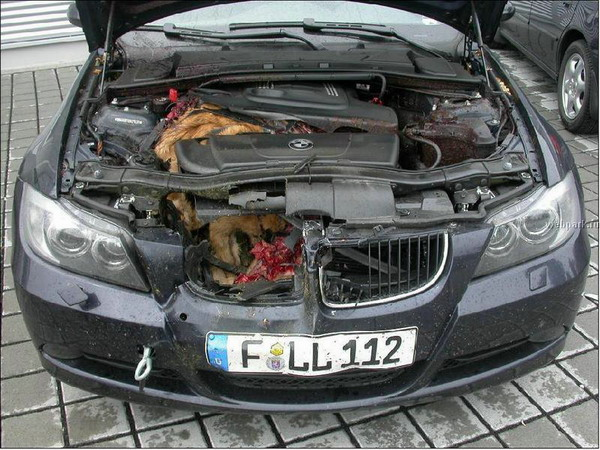
When a BMW hits a Kangaroo

I got this from a friend via email. The pictures look genuine, as far as I can tell. If you don’t want to see, don’t scroll down, OK?


Driving at 225km/h (that’s about 140 mph) out near Mitchell (Qld) in his BMW Z4 the Driver hit a  Kangaroo..
The kangaroo disappeared!
The driver stopped and wondered. Where did the kangaroo go?

Scroll  down to see what he  found……
If you don’t want to see, don’t scroll down.

What I’m Reading: The Wrong Guy by Claudia Teal Whitsitt

In 1969 Katie, a girl from a large, poor, conservative
catholic family in Detroit sets off to college at Eastern Michigan University, and finds herself sharing a room with a more attractive, sexually active, upper class Janie. The action takes place just after  seven murders of young, female college students in the area around EMU – an actual real-life series of killings that Whitsitt uses as the backdrop for the story. Police have arrested the supposed killer, but one of the murders was different to the other six, and some are concerned a killer may still be on the loose.

The book uses lots of contrasts between Katie and Janie to remind us of what was going on in a period of social upheavel. The book is full of references to the culture of the 60s: changing beliefs about sexuality, songs like Aquarius by The Fifth Dimension, Karen Carpenter, Catch 22, orange furniture and smoking being considered sexy. It’s hard to imagine the world of race riots in Detroit, when army tanks rolled down the streets of one of America’s largest cities, or when whites and blacks didn’t mix socially, even on a progressive college campus. The
main character does end up in danger, but I won’t give away the ending. The prose is vivid, the writing style is fluid and it’s a good week-end read. Here’s a link:

http://www.claudiawhitsitt.com/2011/01/the-michigan-murders-and-the-wrong-guy/

Just another WordPress.com site