Could Obama be the Antichrist? Obama’s date of birth was 08041961. If you add all the digits in his birth date together you get 1973. if you subtract the last digit of that from the second digit you get 1673. If you subtract the first digit of that from the third digit you get 1663. Now add the last digit to itself and you have 1666. Now the first digit is telling us there’s only one beast, the Antichrist, so we can ignore that because we already know that. So we are left with one person who is 666.
Michele Bachmann: a prophet for our times!
Where did I get this crazy idea? I owe it all to a US Congresswoman. Although I did the calculation myself, I was inspired by Michele Bachmann, who knows we are living in the end times, and that actions of Barack Obama’s are proof!
So: Will the Fed start printing dollar bills that have serial numbers ending in 666?
What secret building lies at 666 Pennsylvania Avenue? And what secrets can we find hidden in Michele Obama’s date of birth?
I am so grateful for this inspiration, I want Michele Bachmann for Prime Minister of Australia. We need somebody down under to wake us up! Australian politicians are mostly boring. A couple of crazy people would make it much more interesting.
My novel Fire Damage, an action thriller, is available on Amazon Kindle, here. The novel is based on the Japanese religious cult Aum Shinrikyo, which released Sarin nerve gas in the Tokyo subway system in the 1990s. If you don’t have a Kindle, you can download the app to read it on your computer or phone from here. A paperback version is available here. It’s also available as a Kindle on Amazon UK . twitter: @Richard_A_Snow
Sometimes there are people who seem to have guts and moral fibre that leave the rest of us behind. 15-year-old Pakistani schoolgirl Malala Yousafzai was shot in the head and neck a year ago by the Taliban, for advocating that girls should be allowed to go to school.
She had been writing a blog about life in the Swat Valley, where the Talibs were gradually taking over, forcing girls’ schools to close by threats of violence. Violence was so common that one day, when her younger brother was playing in their front yard, she asked what he was doing. “Digging a grave,” he answered. The Taliban found where Malala went to school, got on her bus and fired. The results became world news. After surgery and rehab in England, she is now (this Wednesday) on the anniversary of the attack talking about her future. She can’t go back to Pakistan yet, but she wants to improve her education, and keep pushing.
She has been nominated for a Nobel Peace Prize. It’s a long shot, since there are over 200 nominees. But I hope she gets it.
Malala reminds me a lot of people who have stood up against injustice, and/or to promote the cause of women. Rosa Parks may not have been shot or lynched for refusing to go to the back of the bus with the “coloured folk,” in Montgomery, Alabama, in 1955, but she could have been. Protesters in Egypt two years ago risked death in the hope of democracy. Aun Sung Sui Kee endured 20 years of house arrest in Burma for upsetting the military by winning a democratic election.
The world needs more Malalas. The world need more people like you and I to give to charities that are specifically directed to educating girls in third world countries. The world needs people to put their money where their mouth is.
Malala has a book out, the kindle version is here, and there is a paperback in Book Depository.
Lots of people have been evolving on various things in the last year. In fact, it seems to have become a fashion. In the US, President Obama ‘evolved’ over gay marriage. In Australia, Tony Abbott evolved over paid parental leave. I’m starting to feel myself evolving over, of all things, being (or not being) a vegetarian. I used to think of vegetarians as being a bunch of nuisances who made life difficult for everyone else when it came to choosing restaurants.
Soy-whey protein diet, from US Dept of Agriculture / Wikipedia.
In the last year, I have felt myself change. In part, it was reading about the way animals react in slaughterhouses. Pigs, in particular, I’m told, seem to know they are going to be killed and react, screaming in a way that sounds very human. I’ve also seen some “hidden camera” footage of life inside turkey farms and chicken batteries. In one case turkeys had apparent skin diseases, and farm hands were kicking them like footballs. In another video, chickens appeared to be eating their own dead … what should I call them…siblings? And In Australia we had a big controversy over footage of how Australian animals were slaughtered in Indonesian abattoirs.
Some US states, including North Carolina, have tried to outlaw animal activists getting such hidden tapes.
So I’ve been cutting back on my meat consumption. I haven’t bought bacon for a few months now. I’ve bought free range eggs. The night I write this, I’m going to a Japanese restaurant with some friends. I guess I’ll have a vegetable tempura. One of my main obstacles to going vegetarian has been that the dishes I’ve tried to cook without meat have tasted rather bland. Let’s face it: most vegetables don’t have that much flavor. So I’ve started experimenting with more spices.
I’m still tossing up if I can justify eating chicken meat that was free range before it was killed. I don’t know much about how chickens are killed and how quick or otherwise the process is. I can visualize giving up beef . I may end up as one of those people who eat dairy products and eggs, but not meat. (I just learned that this is called ovo-lacto-vegetarianism.)
So, has anyone who is reading this tried to go to a vegetarian diet? Why did you try it? Did you find it restrictive and boring? Could you stick to it? I’d love to hear.
Please note: this is my blog site. For information about editing an academic thesis click here.
Please note: this is my blog site. For information about editing an academic thesis click here.
Recently I bought a ukulele, and began attending beginners’ classes with the Melbourne Ukulele Kollective (and yes, that is Kollective with a K.) They hold beginner’s classes, free, once a week at a hotel in inner suburban Melbourne. At first it was hard to get from one chord to another, I struggled to keep up with other people. I still do on new songs. But I’m getting faster and a bit smoother at moving from one chord to another.
Ukulele, courtesy of Wikipedia Commons
After attending for about three months, I decided this was something I could stick to, so I bought a more expensive Uke: an eight-string tenor. After six months of attending the group, I decided to do my first performance at the ‘open mike’ night they hold in a bar in Northcote. I practiced Van Morrison’s ‘Brown Eyed Girl.’ I practiced singing the melody into an electronic tuner, which tells you whether you are on-key, flat or sharp. In rehearsals at home, I was on pitch about fifty percent of the time. I figured for a first time effort, that was Okay, so last week I fronted up, performed and got all the chords right. It went well. I felt pleased. There is a simple pleasure in being able to play something well enough to draw a reasonable amount of applause from an audience.
For next month’s open mike, I’m tossing up between the Beatles’ ‘Let It Be’ and Sting’s ‘Fields of Gold.” Would any of my friends care to suggest which is a better song? I’m all ears.
Sometimes, amongst the awful things that happen in the world, you see someone who reacts differently than you expect. Tonight I saw a television item about Michelle Knight, one of the three women who were kidnapped and held in a boarded-up house in Cleveland by school Bus Driver Ariel Castro. They were rescued earlier this year after one escaped and got a neighbor to call the police. Each of the three women was raped, beaten and chained up. One became pregnant and gave birth in the house – her six-year-old-daughter escaped with her.
Michelle Knight
Normally, someone who had been through such an experience would want to disappear from the public view. And mostly they have. But this week, Michelle Knight walked into the court room in which her former rapist and kidnapper was sitting, and delivered what amounted to a victim impact statement – in full view of Castro.
She said, “You deserve to spend life in prison. You took 11 years of my life away and now I’ve got it back. I spent 11 years in hell and now your hell is just beginning. I will overcome all this has happened, but you will face hell for eternity.”
Knight, her voice rising, added, “I will live on. You will die a little every day.”
For her to be able to walk into that courtroom was an act of immense courage. Michelle, I admire and salute you. I hope you have a good life. A fund has been established to assist the women to get back to a normal life. A link to the fund is here.
Last night I went to see The Internship, staring Owen Wilson, Vince Vaughn and Rose Byrne. It’s a classic “fish out of water” story, where the fish makes good against the odds. Two middle-aged guys who know less about technology than the average seven-year-old get an internship at Google because they’ve run out of other job prospects. (The process of getting in seems a little like the way Reece Witherspoon got into Harvard in Legally Blond.) They find themselves with a bunch of twenty year old who can program in C++ and half a dozen languages I didn’t recognize. When asked to design an app, they suggest with something that already exists, and which is already known to all the twenty-somethings. Along the way, they have conflicts with another group of interns who are out to spoil their chances. A love interest arrives half way through the film (like all good Hollywood scripts). In this case she’s supposed to be Australian and she actually is. (Too many ‘Australians’ in American movies are British actors who can only do a half-plausible accent.) The film had a lot of good comedy lines, and they play the tech-newbie aspects of the Owen Wilson for all it’s worth. It’s a good film. You’ll probably like it. Take a night off and go.
The North Korean soccer team is trying to qualify for the next world cup in Brazil. Last time they played in a world cup the coach claimed to be getting instructions form then-leader Kim Jong Ill on invisible mobile phones. Their last match was a nil-nil draw against Cuba.
A guy in Zimbabwe (34-year-old Brighton Dama Zanthe) woke up at his own wake just as he was about to be moved, in his coffin, from his home to the funeral parlor Someone noticed his leg move, and then he woke up. He was taken to a local hospital for two days, and then released.
A Florida man accidentally shot himself in the leg while ten-pin bowling at Jupiter Lanes. He hit himself on the leg with his bowling ball, apparently causing a revolver in his pocket to discharge. Maybe he should keep the gun in a backpack or bag while he’s bowling.
A woman in Horsham, Australia, was about to take her kids to school when her Samoyed dog bought a 20 cm (8 inch) stick of dynamite onto the front porch. The woman decided to leave it at home while she took the kids to school, then retrieved the stick ad took it to her family’s workplace (a road machinery factory at the rear of her property). Then she decided to call the police. The item turned out to be a very large fire cracker. Lucky, but not very smart.
Should there ever be a statute of limitations on murder?
Image from the memorial at the Killing Fields, Cambodia, from Wikipedia Commons.
Tonight I went to see the film ‘The Company You keep”, with Robert Redford and Shia le Beouf. Le Beouf plays a journalist who exposes the identity of one of the Weather Underground, a real-life group of radicals who opposed the Vietnam War, and who bombed several US federal buildings, and robbed cash deliveries to banks in the late 1960s and early 1970s, killing several people. In real life, three members of the group also blew themselves to pieces by accident on 6 March 1970while building a bomb in New York. The bomb was destined for a Non-Commissioned Officers’ (NCO) dance at the Fort Dix U.S. Army base. Some of the real-life weathermen were charged with various offences, some had charges dropped in 1973 after a court decision meant that evidence obtained by illegal electronic surveillance could not be used in court. Several members of the group have ‘rehabilitated’ themselves and re-integrated into society. Yes, I have used the term ‘rehabilitated’ in inverted commas, since I can’t be sure to what extent the surviving members of the group have really changed their views, or to what extent the group simply became irrelevant after the Vietnam war ended.
In the film, Robert Redford is a suspect in a bank robbery carried out in the 1970s, although, as far as I can tell, the specific robbery depicted in the film is fictional. In the movie, Redford was in fact not involved in the robbery, and goes on the run while trying to find someone who could establish his innocence.
As Redford meets up with former members of the Weatherman group, some unpleasant questions came to my mind.
I was in Cambodia teaching English in 2010, when the trial of a former Khmer Rouge leader named Duch took place. (The Khmer Rouge were the Chinese-backed communist group that ruled Cambodia for four years, from 1975 to 1979.) Duch had overseen the Toul Sleng torture centre in Phnom Pehn, where 15,000 people were held and made to ‘confess’ to various crimes being sent to the ‘killing fields’ just outside the city. When I visited Toul Sleng, there was a very rough English translation of the prison rules on display. The first rule was, ‘When I ask you a question you must answer me immediately, or you will get ten hits of the stick, and five shocks of the electric.’ It’s not a nice place.
On 26 June 2010 Duch was found guilty of crimes against humanity and sentenced to 35 year’s jail, or about 9 hours for every person whose torture he oversaw. The sentence was later increased to life imprisonment. The Cambodian government said at the time that only half a dozen more of the old Khmer Rouge leadership would go on trial. The current Prime Minister of Cambodia, Hun Sen, is a former Khmer Rouge leader who defected to Vietnam, and to put every ex-Khmer Rouge leader on trial would probably leave the country with not much of its leadership left.
In other countries that have had civil wars, people have had to make compromises. In South Africa, the ‘Truth and Reconciliation Commission’ heard confessions from former white police officers and prison officers about their activities against blacks during the apartheid era, as well as violations of human right by (black) ANC members who fought the regime. About 900 people were given amnesty for their crimes. The general justification for the commission’s approach was that the country had to acknowledge what had happened in order to have healing, in order to be able to move forward.
In Northern Ireland, there has been a peace process, and Catholics and Protestants are working together in a government. I venture to suggest that if every murder committed during the Northern Irish ‘Troubles’ were fully investigated and prosecuted today, the degree of progress that has been made there might soon evaporate.
I’ve seen American documentaries on the real weathermen, some of whom today still won’t comment on which ‘operations’ they or other members took part in.
I have mixed feelings about all of this. If one of my kids were murdered, I’d want the killer bought to justice, even if it weren’t in the ‘national interest’ of reconciliation. There are people walking around today in the US who have almost certainly participated in murders, but for legal reasons cannot be prosecuted. South Africa, Cambodia, and Northern Ireland appear to have made decisions not to reopen old wounds for pragmatic reasons.
But should murder ever be subject to a forgive-and-forget policy? what do you think?
Would you feel betrayed by this? Imagine that your father, a famous author, wrote a novel that was clearly based directly on your own family, that it was negative in tone, that it described all his dissatisfaction with his wife, and that he included slabs of conversation that you (the daughter) actually had with your father.
That’s what Joseph Heller, author of Catch-22, did in his novel Something Happened. Heller worked on the novel for 13 years. When his daughter read the proof, she was shocked. In the book, the writer talks about his unnamed family members, recounting their faults, and how unhappy he was with them all. He talks about his efforts to intellectually out-fox his daughter. One chapter was entitled, ‘My Daughter is Unhappy’. His daughter, Erica asks, “was this a statement or a goal?” When she asks him why he’s done this, he replies, “What makes you think you’re interesting enough to write about?” What more devastating retort could a father make to his daughter?
In addition, Heller had an affair, which involved flying his lover in the same plane as he and his wife when they went to speaking engagements, and booking the lover into the same hotels. Yes, that’s right- he was carrying on with the lover under the same roof as his wife. When his wife Shirley employed a private detective agency and confronted him with documentary evidence such as credit card bills and photographs, he denied it, and told the rest of his family that Shirley was going crazy and needed a psychiatrist. When Heller was in hospital, Erica walked in on the lover at her father’s bed. Heller calmly introduced them. (The daughter by this time already knew the lover’s name and what she looked like.) After that, Heller reverted to denying the person ever existed. This is strange behavior indeed.
The book gives an insight into what Heller was like as a person, and the answer is, ‘not very nice, really.’ Still, the book is an insight into one of the twentieth century’s best-known writers. It’s well worth reading. Just be prepared to have some illusions shattered. Geniuses can be petulant, vicious and vindictive in their family affairs.
On another note , my novel, Fire Damage, a terrorism thriller, is now available as a paperback, here. It’s also available as a Kindle on Amazon US and UK.It’s based on the real-life Japanese religious cult, Aum Shinrikyo, which released sarin nerve gas in the Tokyo subway system.
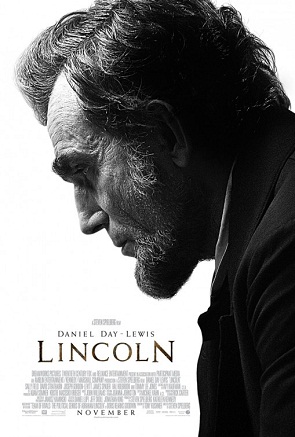
Lincoln – film promotion poster from Walt Disney Studios
Lincoln, staring Daniel Day-Lewis, is a rare glimpse into a fascinating piece of history. It tells the story of Lincoln’s attempt to get the thirteenth amendment to the US constitution (abolishing slavery) through the US Congress in the last months of the civil war. Lincoln was insistent the amendment be passed before the South surrendered, and their pro-slavery delegations re-joined the congress. Others felt the South could be better persuaded to surrender if the amendment did not pass, leaving their economies to manage with the help of slavery.
The acting is superb. Daniel Day-Lewis comes across as a thoughtful, folksy president who enjoyed telling sometimes meandering stories, but was nevertheless a moral and determined man. Sally Field as his wife does a good job as a woman almost over the edge of sanity. (In real life, she was committed to an asylum after Lincoln’s death, but succeeded in getting herself released.) There is tension in the Lincoln family over whether son Robert should be allowed to join the army. Lincoln and his wife are opposed to it, fearing his death, but Robert ignores his parent’s wishes, and joins in the last few weeks of the war. He argues that if he does not join he will be ashamed of it for the rest of his life.
The film seems to contain a lot of shots done in a bluish-grey light, with plenty of shadows and partly lit faces.
It avoids the temptation to dwell too much on the blood and guts aspects of the war, although we are treated to the sight of a wheelbarrow of amputated legs being dumped in a rubbish pit outside a hospital.
For a non-American who had no idea the troubles Lincoln had getting this amendment passed, the film was an eye-opener. It’s well worth seeing, for anyone with even the slightest interest in one of the great historical events of the 1800s.
Note: this is my blog site. For information about my novel, click here. For information about editing an academic thesis, click here.





 Richard Snow Writer